Symphonic Resolve in Ruins
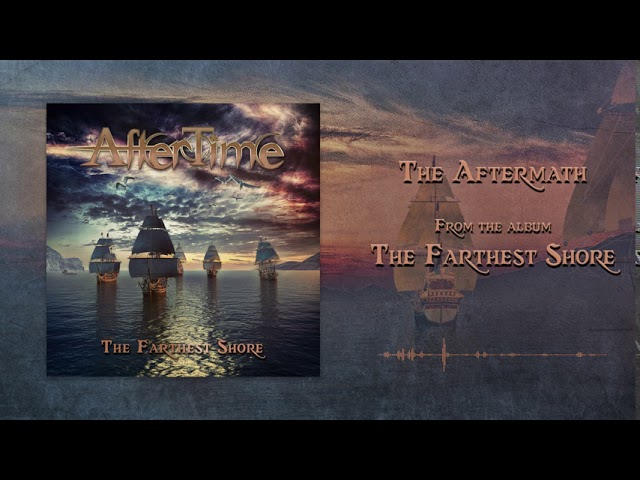
AfterTime’s “The Aftermath,” featuring guest vocalist Melissa Ferlaak, arrives as a focused statement of resilience and renewal, lifted from the band’s album The Farthest Shore. Framed as an official audio release, the track puts the group’s flair for cinematic symphonic metal in sharp relief, pairing orchestral sweep and metallic heft with a lyric that searches for composure amid devastation.
Sound and Arrangement
AfterTime build the song on a familiar but effective symphonic foundation. Layers of strings and brass figures give the arrangement its grandeur, while rhythm guitars supply the propulsion with palm-muted chugs and surging chordal hooks. The percussion accents those swells with precise double-kick patterns and cymbal arcs that underline each dynamic turn. Keyboards and choral pads deepen the harmonic bed, creating a widescreen texture that lets the melody breathe.
Across the verses, the instrumental palette stays taut and supportive, allowing individual lines—guitar harmonies, violin countermelodies, lingering piano figures—to emerge without breaking the momentum. As the chorus arrives, the band widens the stereo field and heightens the contrast, offering the kind of soaring release that defines this corner of symphonic metal. It is a measured escalation rather than a gratuitous blast, grounded in melodic logic and forward motion.
Vocal Presence and Guest Performance
Melissa Ferlaak brings a refined operatic sheen to the track. Her phrasing favors clarity over showmanship, which suits the song’s direct emotional core. She does not dominate the arrangement so much as thread through it, tracing the central melody with light vibrato and carefully shaped dynamics. Where the arrangement thickens, her voice pierces cleanly through, anchoring the refrains with a calm, steady tone.
The vocal writing leans on luminous mid-to-upper registers, and the interplay between the lead line and supporting harmonies adds lift to key phrases. Ferlaak’s presence amplifies that sense of uplift, transforming the chorus into a confident statement rather than a simple hook.
Lyrical Focus: From Embers to Endurance
The text is built on stark, elemental imagery: ashes, glowing embers, wreckage, and debris. That scene-setting acts as a foil for the central message, which is uncompromisingly affirmative. The narrator asserts survival—“You’re still standing, you’re still here”—not as defiance for its own sake, but as a practice of resolve. The pivot from second person to first person (“Hold your ground” gives way to “Hold my ground”) pulls the theme inward, suggesting that empowerment is both shared and deeply personal.
Rather than dwell on catastrophe, the verses emphasize motion, asking for a step at a time until “your road will turn to green.” It reads as a hymn to incremental recovery, eschewing melodrama for steadiness. The musical arrangement mirrors that arc, rising from reflective verses to open-armed choruses that feel earned, not ornamental.
Production and Dynamics
The mix treats the orchestral elements as core architecture, not just color. Strings, brass, and choir occupy a space that complements the guitars rather than competing with them, and the low end stays disciplined so that kick and bass support the grander gestures without clouding the midrange. Vocals sit forward but never oversaturate the spectrum, preserving the sense of ensemble. Crescendos arrive in waves, each one scaled a touch larger than the last, until the final refrain resolves with satisfying inevitability.
Context within Symphonic Metal
Symphonic metal often thrives on excess, but AfterTime’s approach favors clarity and song-first construction. The track checks all the expected boxes—cinematic orchestration, choral lift, resolute riffing—while keeping sight of a clean, memorable through-line. Ferlaak’s guest turn connects the song to the broader tradition of operatic voices in the genre, yet her role here is less about virtuoso display and more about calibrating emotion to fit the narrative.
Moments to Catch
- The opening verse imagery, where strings smolder beneath the vocal to echo the “glowing embers” motif.
- The first chorus ascent, which lands with a firm, uncluttered hook and gives the lyric its most resonant cadence.
- The bridge passage, where orchestral figures expand and guitars tighten, setting up the final chorus with a measured surge.
- The closing affirmation, underscored by layered harmonies that broaden the song’s emotional horizon.
Final Thoughts
“The Aftermath” distills AfterTime’s strengths into a concise, uplifting statement: cinematic arrangement, disciplined power, and a firm grip on melody. With Melissa Ferlaak’s luminous vocal work guiding the song’s ascent from ruin to resolve, it stands as a highlight for listeners who favor symphonic metal with heart, craft, and a clear horizon line.
AfterTime – The Aftermath (feat. Melissa Ferlaak) (Official Audio) Related Posts
- Linkin Park – New Divide – Cover by @Halocene feat. @Violet OrlandiHalocene, in collaboration with Violet Orlandi, has released a cover …
- DystopiaThe article discusses the song "Dystopia" by Witchcraft, featuring members …
- Bridge City Sinners – Devil Like You (Official Music Video)The Bridge City Sinners have released their official music video …
- SEMBLANT – Purified (Official Video)The official video for "Purified" by Semblant, from their album …
- OZZY OSBOURNE – “Lightning Strikes” (Official Video)Ozzy Osbourne's music video for "Lightning Strikes," featured on 'The …
- Butcher Babies – Mr. SlowdeathButcher Babies have released a new single, "Mr. Slowdeath," accompanied …