
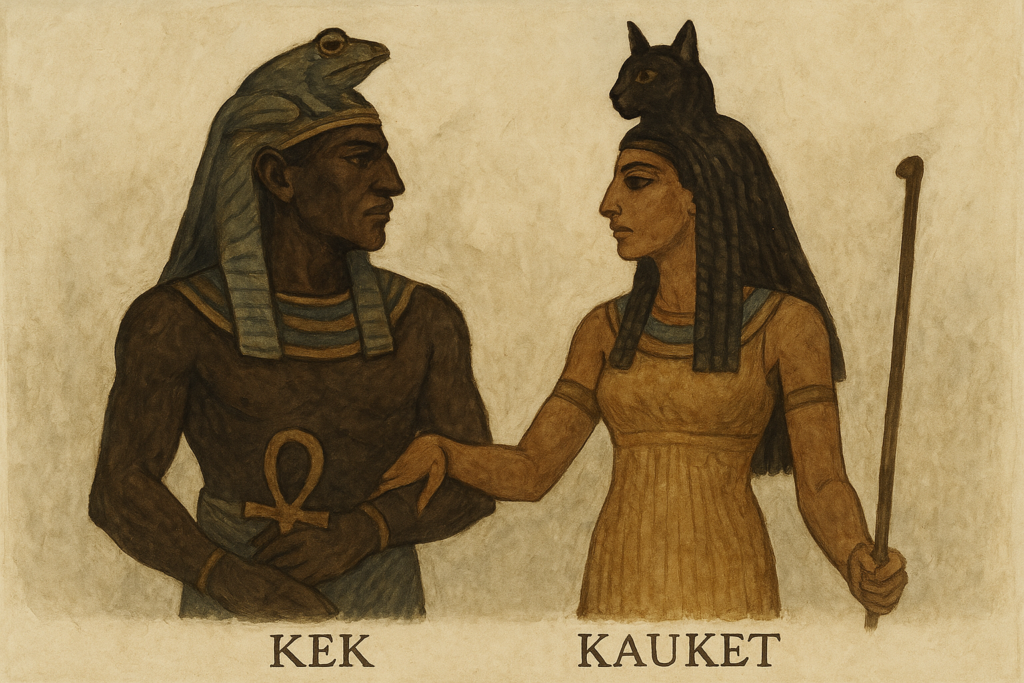
Kek and Kauket are entities from ancient Egyptian mythology, representing the primordial concepts of darkness and obscurity. They embody the chaotic and formless aspects of the universe before creation, serving as a reminder of the void that existed prior to the emergence of light and order. Their significance is rooted in the ancient Egyptians’ understanding of the cosmos and the duality of existence, where light and darkness coexist and balance each other.
Cultural and mythological origins can be traced back to the early dynastic periods of Egypt, with references found in various texts and inscriptions. Kek is often depicted as a frog or as a man with a frog’s head, while Kauket is represented as a snake or as a woman with a snake’s head. Together, they symbolize the darkness that enveloped the world before the sun god Ra emerged, bringing light and life. They are sometimes associated with the concept of the ‘invisible’ or ‘hidden’ aspects of reality, emphasizing the importance of what is unseen.
Attributes and symbolism attributed to Kek and Kauket include their representation of the night and the mysteries that lie within it. They are often seen as guardians of the darkness, holding the potential for creation and transformation. In some texts, they are linked to the concept of time, as darkness precedes the dawn, marking the cyclical nature of existence. This duality is crucial in understanding the ancient Egyptian worldview, where chaos and order are intertwined.
Historically, Kek and Kauket influenced various aspects of Egyptian culture, including religious practices and art. They were invoked in rituals that sought to honor the balance between light and darkness, reflecting the Egyptians’ reverence for the cyclical nature of life. In later interpretations, their roles may have evolved, but the core essence of their representation as embodiments of darkness remained significant. It is important to note that while they are occasionally referenced in later folklore or occult practices, these interpretations diverge from their original mythological context, which remains distinct and rooted in ancient Egyptian belief systems.