A Gospel-Sized Plea Wrapped in Queen’s Studio Brilliance
Somebody To Love stands as one of Queen’s most eloquent fusions of craft and feeling, a piano-driven hymn that channels the fervor of gospel through the band’s unmistakable studio alchemy. First released in 1976 on A Day at the Races, and later featured on the 2014 anthology Queen Forever, the song remains a defining moment in Queen’s catalog, capturing both the vulnerability and power of Freddie Mercury’s writing and voice. The official 1976 promo video, focused squarely on performance, amplifies those qualities without distraction.
From A Day at the Races: Ambition Refined
A Day at the Races arrived after the breakthrough of A Night at the Opera, and it carried forward Queen’s appetite for elaborate arrangements while sharpening their command of feel and groove. The band produced the album themselves with engineer Mike Stone, an important evolution that gave them freedom to pursue bolder textures and tighter vocal designs. Where Bohemian Rhapsody leant into operatic spectacle, Somebody To Love turns toward gospel and soul, proof that Queen’s experimental streak could serve raw emotion as well as grand theatrics.
Writing and Vocal Architecture
Written by Freddie Mercury, Somebody To Love draws clear inspiration from the gospel tradition and the work of soul singers he admired. The song’s 6/8 pulse gives it a swaying, congregational feel, and its signature “choir” is the product of meticulous overdubs by Mercury, Brian May and Roger Taylor. Stacked in dense, luminous blocks, those harmonies mimic a full vocal ensemble, answering Mercury’s lead in an intimate call-and-response. The technique had precedent in earlier Queen recordings, yet here it is directed toward spiritual uplift, less about spectacle than about collective yearning.
Instrumentation, Groove and Dynamics
Mercury’s piano sets the foundation with rolling chords and syncopated accents that tip the song from confessional verse to rousing refrain. John Deacon’s bass threads through the harmony with an elastic, singing tone that brings warmth to the low end. Roger Taylor’s drumming favors a buoyant shuffle, letting cymbal patterns and snare pushes breathe inside the 6/8 feel rather than forcing the tempo forward. Brian May, ever economical, shapes his guitar around the vocal lines, answering phrases with lyrical bends and controlled sustain. His solo feels conversational, almost vocal in contour, intensifying the plea without breaking the song’s devotional character.
The arrangement is carefully staged. The early verses are intimate, with piano and voice in the foreground. Each refrain summons the “choir,” thickening the harmony until the mix blooms. A mid-song breakdown pares the texture back to voice and rhythm, setting up a final ascent where the band and choir lock together for a cathartic release. It is dramatic without theatrical clutter, a build achieved through performance dynamics and layered voices rather than studio trickery for its own sake.
What the Lyrics Ask For
Mercury’s lyric is a direct appeal, equal parts romantic and spiritual. It circles questions of faith, work, rejection and resilience, reaching for solace in the idea that love can still be found through persistence. The language is plainspoken, which only heightens the performance: when the harmonies rise around the line “find me somebody to love,” the arrangement turns private uncertainty into communal affirmation. The effect is inclusive, as if the listener is invited to join the chorus.
The 1976 Promo Video: Performance First
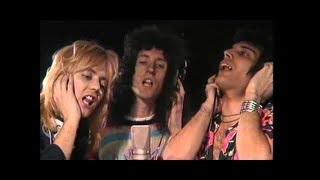
The official video favors an uncluttered, performance-focused approach. The camera lingers on Mercury at the piano, capturing the physicality of his playing and the push of his vocal against the song’s rolling rhythm. Shots of the band singing into a shared microphone emphasize the song’s choir concept without resorting to narrative conceits. Lighting and close-ups underscore dynamics already present in the music, from the restrained verses to the surging refrains. It is a document that trusts the song to carry its own drama.
Key Musical Elements to Listen For
- The 6/8 gospel sway that underpins the piano and drums.
- Layered “Queen choir” harmonies built from multi-tracked Mercury, May and Taylor.
- Brian May’s vocal-like guitar responses and a concise, emotive solo.
- Dynamic staging that moves from intimate verses to towering refrains.
- Call-and-response patterns that frame the lyric as a communal plea.
Releases and Archival Presence
Somebody To Love appears on Queen’s 1976 album A Day at the Races and was supported by the original 1976 promo video highlighted here. The video was later collected on the 2002 compilation Greatest Video Hits 1, providing an official archival context for the clip. The song’s continued prominence in the band’s story was underlined again with its inclusion on the 2014 compilation Queen Forever.
Enduring Resonance
On stage and on record, Somebody To Love has long been a focal point for Queen’s interplay of precision and feeling. Its blend of gospel harmony, rock dynamics and soul-bearing lyric has sustained its appeal across generations and formats. More than a showcase for studio technique, it is a song that understands how collective voices can transform a private ache into a shared release. Decades after its debut, that transformation still feels immediate whenever the opening piano figure begins and the choir of overdubbed Queens gathers to answer.
Queen – Somebody To Love (Official Video) Related Posts
- NITA STRAUSS – Dead Inside (ft. David Draiman of Disturbed)Nita Strauss has released her new single "Dead Inside," featuring …
- Metallica: One (Clisson, France – June 26, 2022)Metallica performed at Hellfest in Clisson, France, on June 26, …
- Metallica: Hardwired (Official Music Video)Metallica's official music video for "Hardwired," featured on their album …
- VISIONS OF ATLANTIS – Melancholy AngelVisions of Atlantis is set to release their new studio …
- AI voicing AI – Belle Vamp voiced by Selene – I Walk the Night (Official Music Video)The official music video for "I Walk the Night" features …
- NIGHTWISH – Over The Hills And Far Away (LIVE)Nightwish's live performance of "Over The Hills And Far Away" …