Setting the Stage
Megadeth’s “Dystopia” lands with the authority of a band rediscovering its sharpest instincts. As the title track of the group’s 2016 album, the song distilled a renewed focus on speed, precision and tightly coiled aggression. The accompanying official video extends that vision into a darkly futuristic world that mirrors the record’s themes, folding Megadeth’s long-standing iconography into a modern, cinematic frame.
The Song: Velocity and Precision
“Dystopia” is built around high-velocity riffing, muscular downpicking and a sense of forward motion that rarely relents. The guitar work is the song’s engine, alternating between muscular mid-register chug and scalpel-precise lead passages. Dave Mustaine’s signature rhythm attack locks into place with David Ellefson’s ironclad bass lines, giving the track heft without sacrificing clarity. The drumming is equally exacting, emphasizing crisp double-kick patterns, tight cymbal work and carefully controlled accents that support frequent shifts in intensity.
Guitar interplay is central. Melodic phrases braid around the main motif, and the solo sections balance technical flash with thematic cohesion. Harmonic movement leans on tense intervals and chromatic turns that keep the ear on edge, while the arrangement creates space for call-and-response moments between lead lines and rhythmic surges. The production favors definition, with each part occupying a clear lane, resulting in a cut that feels both modern and grounded in classic thrash values.
Lyrics and Themes
The lyrics of “Dystopia” frame a vision of societal unraveling, surveillance and the corrosion of truth. Rather than fixating on one narrative, the song sketches a mosaic of decay: fractured institutions, information warfare and the creeping normalization of crisis. Mustaine’s vocal delivery is serrated yet controlled, communicating urgency without lapsing into melodrama. The thematic palette is familiar territory for Megadeth, but here it is sharpened by tight phrasing and imagery that favors stark contrasts over grand declarations.
What resonates most is the song’s mood of skeptical vigilance. “Dystopia” is less a dispatch from a single apocalyptic event than a study of how fragmentation and fear feed each other. The music’s coiled intensity mirrors that stance, oscillating between attack and regroup, tension and release.
The Video’s Visual Language
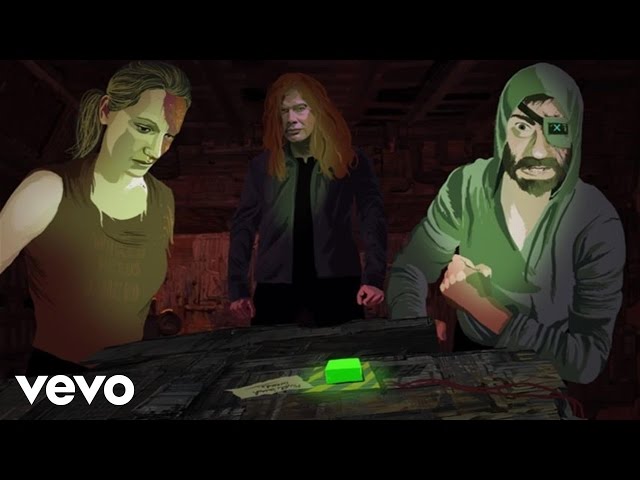
The official music video extends the song’s atmosphere into a charged visual environment. Performance footage of the band is intercut with scenes that echo the album’s futurist motifs: crumbling urban skylines, sterile technological spaces, masked figures and iconography that suggests control exerted at a distance. The editing emphasizes pace and impact, aligning cuts with rhythmic hits and solo runs to reinforce musical dynamics.
Color grading leans toward cold blues and metallic grays, with sudden bursts of light flaring against shadowed backdrops. The palette and staging evoke isolation, surveillance and the abrupt violence of disruption, anchoring the video’s dystopian sensibility without overexplaining its world. It feels like a chapter in an ongoing narrative rather than a closed-loop storyline, which suits the band’s long tradition of building visual continuity around its mascot and artwork.
Performance Chemistry
“Dystopia” captures a lineup in sharp alignment. Mustaine’s riff architecture is answered by lead guitar work that favors articulation over excess, weaving melodic statements into the fabric of the song rather than hovering above it. The rhythm section underlines that approach with a grid-tight pocket, particularly in the way rapid-fire bass and kick patterns reinforce the guitars without muddying the low end.
Small details elevate the performance: staccato mutes that snap like trapdoors, quick modulation in pre-chorus setups, and solo phrasing that nods to classic metal melodicism while staying rooted in thrash velocity. The end effect is a track that moves with purpose, constantly calibrating momentum rather than simply flooring the accelerator.
Artwork, Iconography and World-Building
“Dystopia” sits within a cohesive visual universe that fans will recognize from the album art and accompanying materials. The figure of Vic Rattlehead, reimagined in a futuristic setting, threads through this era as a kind of spectral witness. The video taps that energy, pulling cues from the cover’s cybernetic and post-collapse imagery. The combination of band performance and thematic world-building reflects Megadeth’s longstanding attention to conceptual continuity, where music, visuals and stage presentation reinforce one another.
Place in the Megadeth Canon
Released in early 2016, the Dystopia album marked a pronounced return to high-tempo thrash after a more radio-leaning detour on the prior full-length. New blood in the studio brought renewed bite, and the title track emerged as a focal point of that resurgence. “Dystopia” later earned Megadeth a Grammy for Best Metal Performance, a recognition that underscored how decisively the band had restored its core strengths while updating its sound.
Within live sets, the song quickly took on the role of a statement piece, its taut construction and dynamic shifts translating naturally to the stage. For longtime listeners, it felt like a line connecting the group’s foundational speed-metal roots to a streamlined, present-day execution.
Key Musical Elements
- Riff architecture: tightly wound motifs, precise downpicking, chromatic tension.
- Lead work: melodic through-lines that complement rather than overshadow the main themes.
- Rhythm section: lockstep bass and drums emphasizing clarity and impact at high speed.
- Vocal approach: serrated timbre, pointed phrasing, lyrics that foreground surveillance, decay and misinformation.
- Production: crisp separation of instruments, modern punch without sacrificing grain.
Beyond “Dystopia”
The track’s success helped set the stage for the band’s subsequent chapter, which included the 2022 release of The Sick, The Dying… And The Dead! and an expanded digital presence that folded Megadeth’s iconography into new formats. Initiatives like the Cyber Army 3.0 and its Rattleheads collection extended the visual language introduced in the Dystopia cycle, translating decades of themes into contemporary fan culture.
As a song and a video, “Dystopia” endures because it captures Megadeth in a mode that has always suited them best: alert to the fractures of the moment, musically exacting, and unafraid to refine their blueprint in real time. It is a reminder that precision and urgency, handled with conviction, remain a potent combination.
Megadeth – Dystopia (Official Music Video) Related Posts
- Green Eyes – Saturn – Moon Knows Why | a haunting and emotional ballad inspired by goddess Phoebe"Moon Knows Why" is an emotionally charged ballad inspired by …
- Torture Squad – Return of Evil (Official Music Video)The official music video for "Return of Evil," the title …
- Floor Jansen – Face Your Demons (Live)Floor Jansen's live performance of "Face Your Demons" showcases her …
- Celtic Woman – Tír na nÓg ft. OonaghCeltic Woman's music video for "Tír na nÓg," featuring Oonagh, …
- Belle Mada – Summer Stayed With You | A Song of Love, Memory, and Endless Sunsets (Official Video)"Summer Stayed With You" is a poignant song that encapsulates …
- ( :LOR3L3I: ) Heike Langhans – Dear BrotherHeike Langhans, known as (,LOR3L3I,), presents her latest track "Dear …