A Classic Riff Reframed
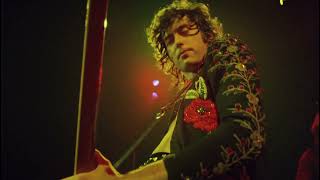
Heartbreaker has long been one of Led Zeppelin’s most explosive stage vehicles, yet in the 1976 concert film The Song Remains the Same it appears only in flashes. Quick cuts and fleeting angles hint at the song’s presence without ever delivering a full performance. This complete live video assembles onstage footage from elsewhere in the movie to create a continuous rendition with a proper ending, offering a clearer sense of how the band drove Heartbreaker across a stage in their early-seventies prime.
Context: The Film, The Era, The Edit
The Song Remains the Same was built from three nights at Madison Square Garden in 1973, a peak moment for Led Zeppelin’s arena-era momentum. The finished film favors extended centerpieces, fantasy sequences, and crowd color over a comprehensive setlist. As a result, some numbers survive only in fragments or as tantalizing inserts. Heartbreaker is among them, its full arc obscured by the edit.
Reconstructing a complete performance from within the movie’s own footage means working with the visual language that defined the film: saturated color, fast handheld zooms, long-lens crossfire from the pit, and those kinetic sweeps across the band. The goal here is continuity. Riff, break, cadenza, finale, applause. The pacing, as much as the images, is meant to restore how Heartbreaker actually breathes onstage.
The Song’s Live Personality
On record, Heartbreaker is a model of hard rock economy, built on Jimmy Page’s barbed main riff, John Bonham’s combustible snare and kick accents, and John Paul Jones’ ballast-heavy bass line. The notorious unaccompanied guitar break slices the song in two before the band slams back in, a device that became even more dramatic in concert.
Live, Heartbreaker expands. Page’s solo section often veers into quicksilver runs and sudden rhythmic feints, Robert Plant teases and elongates vocal phrases, Bonham punctuates the stop-time sections with whipcrack fills, and Jones thickens the low end while mirroring rhythmic punches. The shape is familiar, but the feel is volatile, louder and leaner than in the studio, with the tempo nudged forward just enough to turn swagger into sprint.
What the Video Showcases
Using onstage shots already present in the film, the edit aims to preserve both the grain and the grit. You can trace the musical conversation across faces, hands, and cymbals: the physicality of Page’s right hand on the Les Paul, the way Bonham anticipates a turnaround, Jones’ unflappable precision as the riffs swing wide, Plant’s timing as he slips between the cracks of the beat. It is the chemistry that matters, the tacit signals that keep the thing airborne.
Sound and Interplay: Details to Catch
- The riff as a rallying point: Each return to the main figure tightens the performance, with Page’s attack and Jones’ downbeat alignment locking the groove in place.
- The unaccompanied break: The free-time guitar cadenza, a signature of Heartbreaker since the studio recording, becomes a miniature narrative live. Listen for bursts of blues phrasing, quick scalar climbs, and abrupt rests that set up the crash of the full band re-entry.
- Bonham’s punctuation: Watch the snare placements in the stop-time sections, and the way the kick drum pulls into the riff’s last beat before the turnaround. Those micro-accelerations give the song its snap.
- Plant’s call-and-response instincts: Even without a formal back-and-forth, the vocal phrasing answers Page’s bends and stabs, lending the performance a conversational edge.
- Jones as anchor: Under the fireworks, Jones threads connective lines that glue the transitions, especially as the band surges back in after the solo.
Instrumentation and Stagecraft
The visual language of this era is unmistakable. Page’s Gibson Les Paul into cranked British stacks provides the cutting midrange and sustain that define the song’s bark. Bonham’s Ludwig kit delivers that unmistakable thud and shimmer, cymbals blooming as the room opens up. Jones’ bass tone is round yet articulate, filling the bottom without clouding the kicks and toms. Plant’s presence is pure projection, hair, mic, and spotlight riding the crest of the band’s surge.
The 1973 staging favors minimal adornment: lights, smoke, a sea of faces, and a band that moves with economy rather than choreography. The camera finds what the eye would chase in the room: fretboard close-ups during the break, wide shots for the final downbeats, quick cuts to Bonham’s snare at the exact moment the accents land. It is elemental rock presentation, driven by performance rather than effects.
Why Completing It Matters
Heartbreaker is a keystone of Led Zeppelin’s live language, yet its presence in the film has long felt partial. Presenting it as a coherent performance clarifies how the set once flowed and how the quartet balanced precision with risk. The result is not about unearthing new material, but about granting existing footage the shape the song demands. It restores momentum, gives the solo room to hang in the air, and lets the band hit a final chord that actually feels like an ending.
Final Notes
For listeners who know the studio cut by heart, this live sequence shows how the band stretched that familiarity without breaking it. For those who grew up with The Song Remains the Same’s idiosyncratic edits, it offers a chance to experience Heartbreaker as a full-blooded performance rather than a collage. Turn it up, follow the right hand on the riff, and listen for the precise moment the four pieces snap together. That click is the essence of Zeppelin onstage.
Led Zeppelin “Heartbreaker” live complete video Related Posts
- Avatar – Vultures Fly (Official Music Video)The official music video for "Vultures Fly" by Avatar showcases …
- Metallica – Harvester Of Sorrow"Harvester of Sorrow," a track by Metallica from their 1988 …
- Evil Beauty – Blood and Moonlight (Remix) | A haunting and dark ballad of forbidden love"Blood and Moonlight" is a dark ballad exploring the themes …