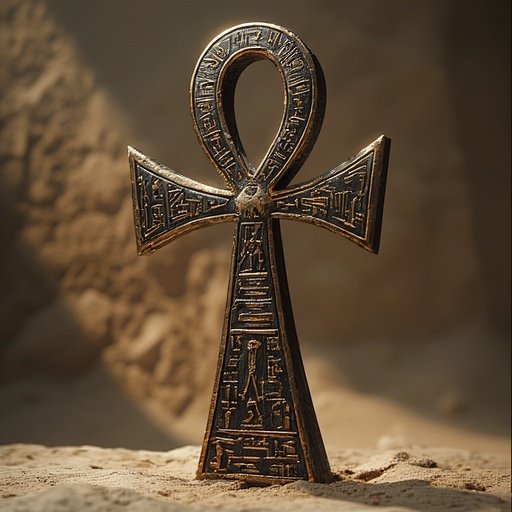
The Ankh, often called the Key of Life, is far more than a decorative hieroglyph of Ancient Egypt. It is a cosmic symbol, representing the principle of life sustained beyond death, the bridge between the mortal and the eternal. Throughout Egyptian theology and later esoteric traditions, the Ankh appears consistently in the hands of specific divine entities, each embodying a distinct aspect of existence, regeneration, and sacred power.
Understanding who carries the Ankh is essential to understanding what it truly means.
Osiris — Lord of Resurrection and Eternal Continuity
Among all deities, Osiris is perhaps the most profoundly linked to the Ankh.
As god of the afterlife, rebirth, and cyclical renewal, Osiris embodies the Ankh’s promise that life does not end with physical death. In countless reliefs and funerary texts, Osiris holds the Ankh as a seal of eternal survival, granting the deceased passage into the Duat and continuity beyond decay.
In this context, the Ankh is not merely life — it is life restored.
Isis — The Giver of Breath and Magical Life
Isis, goddess of magic, motherhood, and divine wisdom, is frequently depicted offering the Ankh to pharaohs and souls alike.
Her association reveals a deeper layer of the symbol:
the Ankh as breath, magic, and conscious vitality.
Isis does not rule life abstractly — she animates it. Through her spells, she resurrects Osiris, protects Horus, and sustains the cosmic order. When Isis holds the Ankh near the lips of a king or initiate, it symbolizes the transmission of divine essence, not authority alone.
In later esoteric readings, Isis becomes a proto-figure of Sophia — sacred wisdom that awakens life from within.
Anubis — Guardian of Thresholds and Sacred Passage
Though often associated with death, Anubis is a god of transition, not annihilation.
When Anubis appears with the Ankh, the symbol represents safe passage between states: life to death, ignorance to knowledge, chaos to order. The Ankh here functions as a key, aligning perfectly with Anubis’ role as guide and protector of souls.
This pairing reinforces the idea that the Ankh is not opposed to death — it mastery over it.
Ra — Solar Vitality and Cosmic Life Force
The sun god Ra frequently carries the Ankh as an emblem of creative power and sustaining energy.
In solar theology, the Ankh represents the life force that fuels creation itself, radiating from Ra into the world. Pharaohs receiving the Ankh from Ra are not merely blessed — they are infused with solar vitality, a divine mandate to maintain Ma’at (cosmic balance).
Here, the Ankh transcends the personal soul and becomes cosmic respiration.
Hathor — Life, Sensuality, and Sacred Joy
Hathor, goddess of love, music, beauty, and ecstatic states, is another frequent bearer of the Ankh.
In her hands, the symbol represents life as pleasure, connection, and creative flow. Hathor’s Ankh is not solemn — it is vital, embodied, and celebratory. It affirms that life is not only survived, but experienced deeply.
This association later influenced mystical and tantric interpretations of the Ankh as the union of opposites — masculine and feminine, spirit and flesh.
Horus — Divine Kingship and Living Consciousness
Horus, the falcon god and symbol of rightful rule, receives the Ankh as a mark of living divine authority.
Unlike Osiris, Horus represents life in action, awareness in the present world. The Ankh here signifies conscious life, sovereignty rooted not in domination, but in alignment with cosmic law.
It is life that sees, acts, and protects.
Beyond Egypt — Esoteric and Gnostic Echoes
In later mystical traditions, especially Hermetic, Gnostic, and occult systems, the Ankh was reinterpreted as:
- The union of spirit and matter
- The feminine womb and masculine cross
- A symbol of hidden knowledge that grants life through awakening
These traditions often associate the Ankh with archetypal figures such as Sophia, the Serpent of Wisdom, and the eternal feminine principle — entities that, like Isis, restore life through knowledge rather than obedience.
The Ankh as a Living Symbol
Across gods, myths, and centuries, one truth remains consistent:
The Ankh is never passive.
It is given, offered, activated.
Whether held by Osiris, Isis, Anubis, or Ra, the Ankh always marks a moment where life crosses a boundary — death, ignorance, silence, or form.