A Late-Era Statement From a Thrash Institution
By the time Slayer released World Painted Blood in 2009, the band had nothing left to prove. Yet the title track, and the album that bears its name, arrived with a vitality that cut through complacency. It captured the classic ferocity of the group while introducing a rawer, almost live-in-the-room immediacy. The studio lineup of Tom Araya, Kerry King, Jeff Hanneman, and Dave Lombardo sounds urgent and dangerous, channeling familiar extremity into songs that feel uncomfortably close to the skin.
The title single stands at the center of that impact. It is a portrait of collapse set to strafing guitars and whipcrack drums, the kind of Slayer song that builds an entire world, then scorches it to the ground. Released via American Recordings, it reinforced the band’s standing as one of metal’s most unflinching narrators of societal decay.
The Title Track: Poisoned Atmosphere, Surgical Execution
“World Painted Blood” moves with a stalking tension that blossoms into speed. The guitars sketch a grim topography with razor-edged downpicks and shifting accents, while the rhythm section drives like an engine pushing into the red. Araya’s phrasing is clipped and cold, less a storyteller than a witness to catastrophe. Instead of a single headlong charge, the arrangement breathes: verses lunge, choruses open into a wider blast, and the bridge twists the tempo just enough to yank the ground from beneath the listener.
The detail work is key. Lombardo locks into double-kick patterns that never feel mechanical, sending bursts of momentum through each transition. Hanneman and King carve atonal leads that avoid heroic resolution, opting for serrated lines and dive-bombs that feel like alarms going off. The interplay highlights one of Slayer’s enduring strengths, the sense that riffs are weapons and space is as violent as sound.
Lyric Themes: Human Frailty at Catastrophic Scale
Across the album, the writing circles around obsession, dehumanization, and the machinery of violence. On the title cut, those ideas expand to a planetary view. The language is clinical rather than poetic, favoring imagery of disease vectors, boundary lines, and spreading contamination. It feels diagnostic. The song’s refrain doesn’t promise salvation or redemption, it observes the stain seeping outward, indifferent to borders and allegiances.
This perspective threads through the record at large. Slayer’s thematic universe has always included religion, war crimes, and psychosis, but here the focus often shifts from the individual monster to systems and conditions that create them. The moral weather is bleak and unadorned. It is this reportorial distance, set against violence in the music, that gives World Painted Blood its unnerving clarity.
Production and Process: Urgency on Tape
Producer Greg Fidelman captured a sound that places the band close to the listener. Guitars are taut and serrated, drums sit forward without blurring the edges, and Araya’s vocals slice through with a hoarse authority. Compared to the meticulously layered approach common in modern metal, the record has a volatile presence. It feels like a band in a room, tightening bolts as they play. That energy extends to the title track’s structure, which resists over-polish in favor of momentum and bite.
The creative process was reputedly more fluid than in some earlier cycles, with ideas hammered out in the studio rather than being road-tested for years. The result carries an element of risk. You can hear parts pushing against each other, lines jostling for dominance, and then snapping into alignment at the last possible second. It is part of what makes the song so alive.
Musicianship: The Classic Lineup at Full Voltage
At this point in Slayer’s arc, the chemistry between the four members operated like muscle memory with a mean streak. Lombardo blends precision with elasticity, constantly shifting cymbal articulations and ghost notes to change the weight of a groove. Araya’s bass often doubles the guitars, adding urgency to the downstrokes, yet his sense of timing keeps the low end from becoming a monolith.
Guitar-wise, Hanneman’s writing still carries a distinct, angular menace, while King’s solos erupt like electrical faults. The tonal character is bright enough to cut yet thick enough to slam. Chords lurch in and out of chromatic dissonance, and palm-muted machines gun across the barlines, a signature that remains instantly identifiable. In “World Painted Blood,” these elements crystallize into a kind of controlled chaos, each section ratcheting tension before the band detonates the release valve.
Visual Language: The Music Video’s Grim Cartography
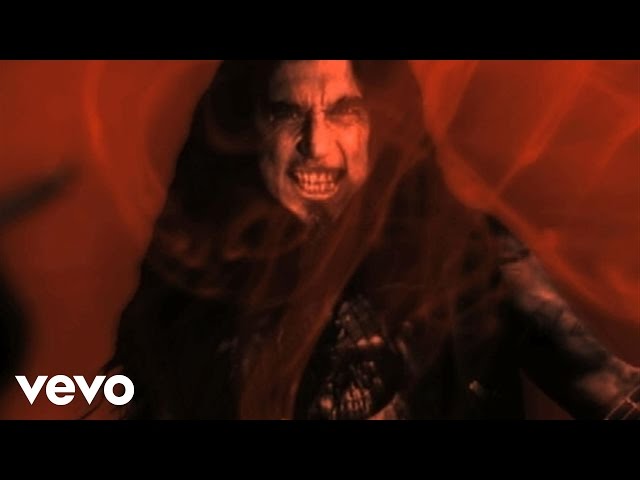
The official video amplifies the song’s apocalyptic thesis with stark, graphic imagery. A limited color palette, quick intercutting, and documentary-style fragments point to a world where symbols and newsreel horrors blur together. Rather than literalize the lyrics, the visual approach leans on suggestion and repetition, turning maps, bodies, and ink-like spreads into a single, suffocating motif. The effect is less narrative than atmospheric. It feels like being trapped inside the smear of the title, watching it spread.
In the broader release campaign, the album’s artwork echoed the same idea, with alternate covers depicting different world maps rendered in blood. It was a rare case of metal packaging and music meeting at the same conceptual altitude.
Wider Context: A Brutal Benchmark in a Changing Era
When World Painted Blood landed, thrash was enjoying a renewed spotlight. Legacy bands were touring harder, younger acts were borrowing and bending the form, and production standards were shifting across heavy music. Slayer’s title track avoided nostalgia and trend-chasing. It fell squarely in the lineage of the band’s cruellest, clearest statements, yet felt attuned to a contemporary anxiety that was global in scale.
Historically, the album holds a special place. It would be the final Slayer studio record released with Jeff Hanneman in the lineup during his lifetime, and it also captured Dave Lombardo in a late-career run of ferocious form with the group. The title cut now reads as a marker of that convergence, a late-era summation that does not soften the edges.
Details That Keep Pulling You Back
- The way the drums switch from a stalking mid-tempo pulse to surge patterns, shifting the ground under the riffs without losing clarity.
- Lead breaks that refuse catharsis, spiking tension rather than resolving it.
- Araya’s clipped delivery, which frames the lyric as a cold report, not a confession.
- Guitar tones that keep articulation sharp even at high speed, letting dissonant intervals snarl instead of blur.
Final Thoughts
“World Painted Blood” is Slayer doing what only Slayer can do: scan the horizon, chart the threat, and then render that feeling in riffs and rhythms that feel both inevitable and out of control. As the spearhead of the album, the song compresses decades of vocabulary into four minutes of escalation. It is a late-career highlight, a hard proof that the band’s core language of speed, dread, and precision still carried the power to redraw the map.
Slayer – World Painted Blood Related Posts
- Belle Nix – Crimson Chains of Fire | A powerful song that dives into imagery of ruin, and rebirth"Crimson Chains" by Belle Nix is a powerful song that …
- SIRENIA – Voyage VoyageSirenia has released a cover of Desireless' iconic 1980s song, …
- Garbage – I Think I’m ParanoidThe music video for "I Think I'm Paranoid" by Garbage, …
- The Second Moon Rises – Mirror of the Void | The first physical clash between the rebels songThe song "The Second Moon Rises - Mirror of the …
- Evanescence’s Amy Lee Performs Using a Hello Kitty KeyboardEvanescence's Amy Lee recently showcased her musical versatility by performing …
- OMNIUM GATHERUM – Maniac (OFFICIAL VIDEO)Omnium Gatherum has released the official video for "Maniac," a …