Blues Heat in an Intimate Room
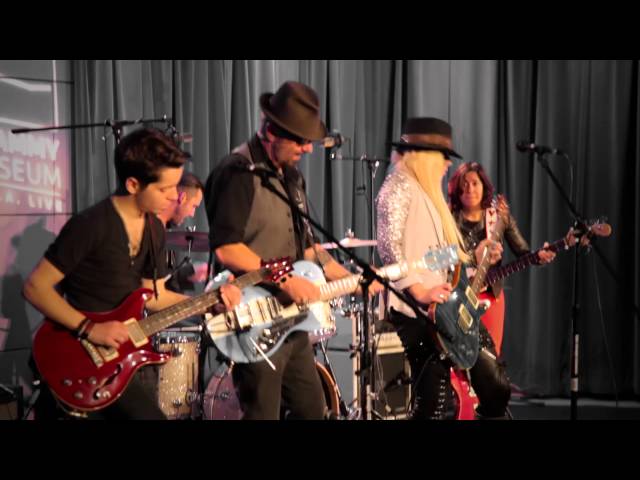
In a tightly focused, invitation-style setting at the GRAMMY Museum, guitarist and vocalist Orianthi joined songwriter, producer and Eurythmics co-founder Dave Stewart for a raw, close-quarters performance that put tone, touch and chemistry under the spotlight. The pair leaned into a gritty reading of “Filthy Blues,” a cut aligned with the sessions behind Orianthi’s album Heaven In This Hell, and used the museum’s low-lit theater to strip the song back to its bones. Filmed by Cyril Niccolai, the moment captures two artists folding swaggering blues into modern rock contours, with room to stretch and improvise.
Partners in Grit and Melody
Orianthi and Stewart have a creative relationship rooted in mutual respect for riffs and songwriting. Stewart’s production aesthetic favors live tracking, saturated tones and the kind of imperfections that make blues-rock breathe. Orianthi brings sharpened lead technique, a punchy vocal presence and a knack for melodic hooks that cut through the mix. Together, they move comfortably between radio-ready structure and the unvarnished immediacy of a jam, the kind that demands eye contact and fast ears. This performance distills that union into something lean and combustible, letting the song’s core rhythm and emotive pull do the talking.
The Song’s Pulse and Feel
“Filthy Blues” lives where swampy groove meets arena muscle. The riff sits thick in the mids, with a rattling, slightly overdriven chassis that nods to a well-worn tube amp pushed just past polite. Rather than chase speed, the arrangement leans on a sturdy pocket, giving the phrases time to land. You can hear the lineage of traditional 12-bar building blocks, yet the cadence and vocal phrasing carve a contemporary shape. There is a tension between grit and polish, a conversation between the barroom and the big stage, that informs every turnaround.
Technique, Tone and Interplay
Part of the pleasure here is textural. Orianthi’s right-hand attack is assertive but controlled, articulate in the pick strokes and keen on those half-step bends that bloom into full-voiced notes. Her vibrato is wide enough to feel dangerous, never so wide that it loses pitch focus. Stewart, long known for his taste and restraint, supplies a sinewy rhythm bed, the kind that lets a lead player breathe. He punctuates choruses with clipped chord stabs, then tilts into more open voicings as the song swells. Their call-and-response passages favor phrasing over flash, two players leaving space for the other to answer.
Sonically, the performance straddles crunchy electric textures and the warmth of semi-hollow resonance. Guitar voices stay dirty but intelligible, with a touch of room air audible in the microphones, a reminder that this is music happening in a space, not in a vacuum. The solos lengthen without derailing momentum, building on motifs introduced in the verses, and resolving back into the main riff with satisfying weight.
Blues Themes, Contemporary Edges
Lyrically and emotionally, “Filthy Blues” sits inside timeless blues territory, power struggles and temptation given voice through tough talk and confession. What reads as defiance also reads as self-possession, a singer pushing back against chaos with swagger. The larger Heaven In This Hell cycle frames these tensions in stark light and shadow, the promise of relief against the drag of vice. There is agency in the way the melody leans into the grit, a sense that the rougher textures are not a problem to be solved but a place to stand.
Captured in the Moment
The camera work by Cyril Niccolai favors proximity, catching quick glances between the two players and the micro-expressions that drive small-room performances. That closeness amplifies the dynamics. You hear shoes on the floor, strings squeak under pressure, and the slight swell of the room when a chorus hits harder. The documentarian angle does not tidy anything up, which is precisely the point. In a museum setting that often privileges context and conversation, this clip privileges the heat of the performance itself.
Context Within Orianthi’s Catalog
Heaven In This Hell marked a turn toward rootsier textures in Orianthi’s recorded work, without abandoning the precision and fire that built her reputation. The writing and arrangements from these sessions pull country, blues and classic rock into the same orbit, then throw sparks with concise choruses and muscular guitar arrangements. Stewart’s production sensibility encouraged that meld, favoring first-take electricity and performances that feel lived-in rather than lacquered. “Filthy Blues,” in this setting, reads like a thesis statement for that approach, the dirt and the gloss doing business on equal footing.
Why the Museum Stage Suits the Music
The GRAMMY Museum’s theater is built for intimacy, for performances where nuance reads like a headline. Blues-rock benefits from that scale. Subtle tempo pushes, a clipped inhale before a chorus, the bloom of a sustained chord, these details land with clarity. For a song that relies on feel more than arrangement sleight of hand, the venue operates like an instrument. The audience proximity tightens the groove, and the acoustics lift the harmonics off the strings without washing them out.
Performance Highlights
- A thick, mid-tempo riff that anchors the song while leaving space for vocal phrasing.
- Lead lines built on blues phrasing and modern articulation, economical and song-focused.
- Rhythmic guitar that prioritizes feel and pocket, with tasteful accents under the choruses.
- Dynamic swells into the refrains, earned through restraint in the verses.
- A live mix that favors organic grit, the sound of wood, wire and tubes in motion.
What This Collaboration Underscores
Artists move through cycles. They sharpen and unlearn, add tools and put others down. This museum set preserves a point on that arc where Orianthi and Dave Stewart chose feel over flash, atmosphere over excess. It is instructive in how the blues can be a foundation rather than a costume, how a tight groove and a strong voice carry more voltage than a crowded arrangement. In the long view of both artists’ catalogs, “Filthy Blues” stands as a reminder that the most direct path from stage to listener is still the combination of a sturdy riff, a clear melody and the courage to leave space.
Filmed by Cyril Niccolai, the performance remains a compact document of two distinct musical personalities choosing the same lane and flooring it. No pyrotechnics, no safety net, just the dirt and the shine, locked to the same backbeat.
Orianthi, Filthy Blues , Dave stewart live at Grammy museum Related Posts
- Belle Nielis – Three Sisters of Avalon | A lyrical tribute to the mystical priestesses said to dwell"The Three Sisters of Avalon" is a lyrical homage to …
- FROZEN CROWN – Kings (Official Video) 4K UHDFrozen Crown has released the official video for their song …
- WITCHCRAFT – It’s Not Because of You (OFFICIAL SONG PREVIEW)Witchcraft has released a preview of their new song "It's …
- Evil Beauty – The Feather of Truth | A cosmic balance and the pursuit of justice (Official Video)"The Feather of Truth" explores the ancient theme of cosmic …
- THUNDERMOTHER – Loud And Free (2022) // Official Music Video // AFM RecordsThundermother's latest single, "Loud and Free," from their album "Black …
- The Jimi Hendrix Experience – All Along The Watchtower (Official Audio)The official audio for "All Along The Watchtower" by The …