A Gateway Into White Zombie’s Fever-Dream Aesthetic
“Welcome to Planet M.F.” captures White Zombie arriving at full power in the early 1990s, a band translating its comic-book occultism, grindhouse obsession and club-floor groove into a visual and sonic barrage. Issued under Geffen Records in 1992 and now presented in an HD remaster, the official music video distills the group’s signature collision of metal riffing, mutant funk rhythms and B-movie ephemera into three frantic minutes that feel like a transmission from a flickering midnight channel.
Where It Sits in the Band’s Arc
The track appears on “La Sexorcisto: Devil Music Volume One,” the album that introduced White Zombie’s maximalist vision to a wider audience. The group’s lineup at the time — Rob Zombie on vocals, Jay Yuenger on guitar, Sean Yseult on bass and Ivan de Prume on drums — had locked into a heavy, danceable engine that turned horror-show imagery into kinetic rock theater. The record’s aesthetic, honed through relentless touring and a deep fascination with cult film and pulp art, gave the band a distinctive space within the nascent alternative metal landscape.
Sound: Groove as a Weapon
“Welcome to Planet M.F.” is driven by a mid-tempo churn that favors swing and space over speed. The rhythm section works like a hydraulics system, lifting and dropping the riff to create a constant sense of lurching forward motion. Yseult’s bass carves rubbery lines that reinforce the downbeat, while de Prume swings between four-on-the-floor insistence and tom-heavy accents that amplify the song’s ritualistic feel.
Yuenger’s guitar tone is thick and slightly corrosive, with a percussive right hand that punches through the mix. The riffing leans on palm-muted chugs, slides and tightly coiled figures that open into gnarled, descending hooks. Effects are used for texture rather than show, with occasional filter sweeps and noise bursts that smear the edges of the groove.
Rob Zombie’s vocal is part bark, part carnival barker, organizing the chaos with chant-like refrains and clipped, call-and-response cadences. Snippets of dialogue and found-sound detritus shadow the voice, tying the song to the band’s collage tradition and deepening the sense of a haunted broadcast assembled from late-night TV and VHS stacks.
Themes and Imagery
The lyric world of “Planet M.F.” imagines a sleazy, sci-fi funhouse where hot-rod menace, occult posturing and trash-culture poetry swirl together. It is not a narrative so much as a montage of symbols: neon hellscapes, grindhouse violence hinted at rather than described, and a fixation on speed, flesh and spectacle. The hook functions like a gate code to the group’s universe, welcoming listeners into a domain where pulp becomes liturgy and kitsch becomes power.
Inside the HD Remaster
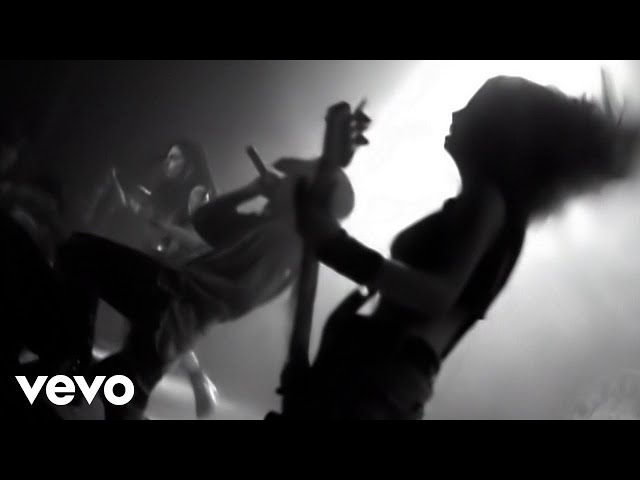
The remaster sharpens the visual grit that defines White Zombie’s early videos. Film grain is more legible, color saturation pops, and quick-cut edits retain their disorienting rhythm while reading cleaner on modern screens. The boosted clarity highlights details of the band’s stagecraft — painted backdrops, distressed textures, strobes and smoke — without polishing away the original underground feel.
Editors lean on cut-up techniques and rapid montage to mirror the music’s lurch and grind. Negative exposures, colorized flashes and spliced-in ephemera give the frames a found-footage volatility. The result resembles a psychotronic fanzine in motion: hand-assembled, brash and intent on overwhelming the senses.
Key Sonic and Visual Hallmarks
- Groove-centric heaviness: a locked, mid-tempo engine that prioritizes swing and repetition over shred.
- Collage aesthetics: sampled voices and noise fragments woven into the arrangement for atmosphere and momentum.
- Riff minimalism: muscular patterns with small variations that accumulate tension.
- Vocal incantations: chants and clipped phrases used as rhythmic anchors.
- Grindhouse palette: saturated color, grain, strobe and quick cuts that evoke drive-in cinema and zine culture.
Production Context
The “La Sexorcisto” era is associated with a dense, high-contrast sound that balanced club-ready punch with guitar-forward impact. The mix gives each element a distinct lane, clarifying the band’s hybrid of metal, funk and industrial-adjacent texture. Layering is key: riffs, low-end throb, percussion accents and sampled fragments interlock to create a wall that remains breathable. That approach, and the album’s overall presentation, helped define a template for groove-minded heavy music in the decade to come.
Performance Personality
White Zombie’s chemistry is central to the video’s charge. Rob Zombie’s frontman theatrics hinge on physical rhythm and graphic silhouette, while Yseult and de Prume act as the machine room, maintaining a relentless pull that makes the visuals feel perpetually off-balance but grounded. Yuenger’s stance and attack translate the record’s crunch into a tactile stage presence. The camera lingers on these components just long enough to let each one register before the edit yanks the viewer to the next jolt.
Why It Endures
“Welcome to Planet M.F.” endures because it turns a very specific set of subcultural interests into pop-literate immediacy. The band’s fascination with exploitation cinema and outsider art becomes not just decoration but structure, informing how the music moves and how the picture cuts. The HD remaster brings renewed punch to that design, offering a clearer view of White Zombie’s technique without compromising its scuzzy charm.
For listeners tracing the band’s development, the track sits alongside “Thunder Kiss ’65” and “Black Sunshine” as pillars of the era, each showing a different facet of the same sonic architecture. “Planet M.F.” is the doorway, a loud and lurid welcome that still feels like a dare.
White Zombie – Welcome To Planet M.F. (Official Music Video) Related Posts
- The Second Moon Rises – Ashes by the Gate (FEAT : Part 1 UFO Man, Part 2 Green Eyes)The song "Ashes by the Gate" explores themes of disillusionment …
- Belle Vamp – Blood Moon Serenade | The seductive and haunting beauty of a vampire’s under the moon"Blood Moon Serenade" captures the enchanting yet perilous allure of …
- Within Temptation – Entertain You (Official Video)Within Temptation has released the official music video for their …
- The Heimatdamisch: Sweet Child o’ Mine (Guns n’ Roses)The Heimatdamisch presents their rendition of "Sweet Child o' Mine," …
- WHYZDOM – Symphonic Metal – Tears Of A Hopeless God (Official music video)The official music video for "Tears Of A Hopeless God," …
- WALK IN DARKNESS – On The Road To Babylon (Official Video)The official video for "On The Road To Babylon," a …