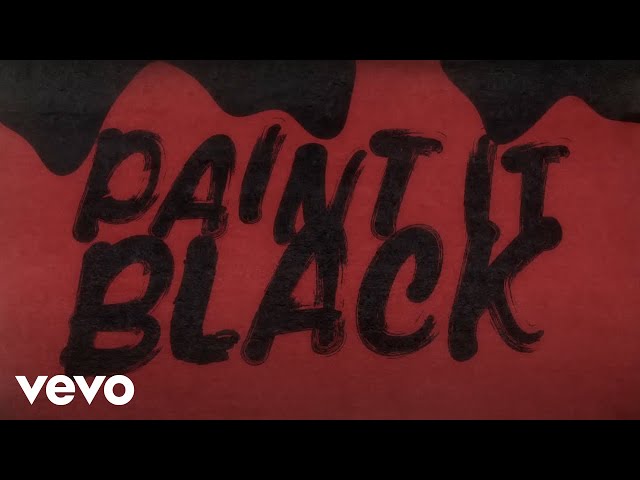
Dark Pop Perfection Reframed
Few singles in 1960s rock balance menace and melody as precisely as The Rolling Stones’ 1966 classic “Paint It, Black.” Its official lyric video, released by ABKCO Music & Records, Inc. in 2015 and directed by Hector Santizo, offers a sharp reminder of why the song still feels unsettling and magnetic. By foregrounding the words, the clip re-centers a track often remembered for its iconic sitar riff and relentless pulse, revealing the tight interplay between language, arrangement, and a band pushing itself into new territory.
Origins and Mid-60s Crossroads
Recorded during the Aftermath sessions in Los Angeles and produced by Andrew Loog Oldham, “Paint It, Black” arrived as the British Invasion’s first wave gave way to broader experimentation. Mick Jagger and Keith Richards had been refining their songwriting at a rapid clip, and Brian Jones, increasingly interested in non-Western instrumentation, provided the sonic catalyst that set this single apart. Issued in 1966 and included on the US edition of Aftermath, the song marked a moment when the Stones’ gritty R&B roots merged with a darker, more cinematic sensibility that would define much of their late-sixties output.
A Sound Built on Tension
The track’s atmosphere is forged by contrasts: a brisk tempo against a minor-key melody, a tightly wound rhythm married to an elastic, raga-inflected lead line. Jones’ sitar locks into a hypnotic motif that acts as both hook and drone, while Keith Richards’ guitar and Bill Wyman’s bass reinforce a compact framework that never loosens its grip. Charlie Watts drives the song with clipped snare work and metronomic steadiness, creating a forward surge that feels both danceable and ominous. The arrangement is spare in its components yet rich in cumulative effect, with percussive accents sharpening the edges of an already taut performance.
Harmonically, “Paint It, Black” courts modal color without abandoning the concision of a pop single. The sitar’s timbre delivers an immediate otherness, but the band resists psychedelic sprawl in favor of punch and clarity. That restraint is crucial: melodic ideas return with a mantra-like insistence, then tilt into slight variations that deepen the sense of unease. The song lasts only a few minutes, but it suggests a much wider emotional and sonic landscape.
Words That Refuse the Light
Jagger’s lyric compresses grief, denial, and fatalism into vivid, repeatable images. The recurring red door and insistence on blackening every bright surface pull private sorrow into public view. The singer watches a world moving past him, “girls… in their summer clothes” and a “line of cars,” then pivots inward to confess an inability to face facts. The language is unadorned, almost stark, yet it lands with clarity: a refusal of color becomes a metaphor for obliteration, and the refrain hammers at the urge to make the external world mirror an internal void.
What keeps the song from sinking into gloom is its precision. Each line advances the psychology of the narrator without melodrama. Even the most direct images, like funerary flowers or the setting sun, serve the structure rather than overwhelm it. Jagger’s vocal, urgent but controlled, mirrors the band’s pacing. He sounds like someone trying to outrun a thought that keeps returning with the same velocity as Watts’ snare.
Brian Jones and the Expanding Palette
Jones’ sitar work on “Paint It, Black” is a pivotal element of the Stones’ mid-60s evolution. Across this period he broadened the group’s tonal vocabulary, introducing textures that reframed the band’s core blues instincts. Here, the sitar does more than decorate. It carries a central motif that redefines the song’s identity, situating the Stones within the era’s growing curiosity about global sounds without surrendering their bite. The result is raga rock that avoids cliché, anchored by a rhythm section that stays ruthlessly on task.
Production and Performance Focus
Andrew Loog Oldham’s production captures urgency and economy. Nothing wanders, nothing sprawls. The mix places the sitar and vocal in close conversation, while guitar and bass compress the harmonic space to maximize drive. Even as the band explores new timbres, the recording holds to a directness that suits the single format. It is music arranged for impact, with dynamics shaped by arrangement choices rather than studio excess.
As individual players, the Stones move with a collective discipline. Richards’ guitar parts avoid showy flourishes, emphasizing pulse and counterline. Wyman’s low end stitches the sections together, shadowing the vocal cadence and giving the sitar a stable floor. Watts, characteristically unflashy, makes momentum feel inevitable. The effect is a song that sounds both immediate and hard to escape, a perfect frame for the lyric’s compulsion.
The Lyric Video as Lens
Directed by Hector Santizo and produced by Julian Klein, Robin Klein, Mick Gochanour, and Santizo, the 2015 official lyric video underscores the song’s structural clarity. Contemporary lyric videos can sometimes reduce complex songs to typography, but here the approach functions as a spotlight. By placing the text at the center, the clip compels attention to the repetitions and shifts that give “Paint It, Black” its momentum. The visual economy mirrors the track’s own: stark elements, strong contrasts, and no wasted motion.
For catalog material as iconic as this, a lyric video can serve archival and interpretive roles at once. It refreshes the song for digital-native audiences while reminding long-time listeners how the words lock into the groove. The familiar tension surfaces anew: the chorus lines that dominate popular memory collide with the verses’ more private admissions. The clip is less a reinterpretation than a clear window, revealing why the song’s language still pierces.
Place in the Stones’ Story
“Paint It, Black” sits at a hinge in The Rolling Stones’ development. The band had already proven its capacity for swaggering R&B and blues-based singles. With this track they intensified their lyric focus, expanded their instrumental reach, and signaled a willingness to darken the palette without losing their grip on concision. The song anticipates the moodier hues that would color later work while standing as a self-contained statement: a lean, unforgettable single that introduced a broader sonic world to mainstream rock.
Enduring Echoes
Decades after its release, the song’s influence remains audible. Musicians across genres have gravitated to its elegant, forceful design, and its imagery has become shorthand for a particular kind of pop existentialism. Yet what continues to resonate is its balance. It is both catchy and cold-eyed, both experiment and hit. The lyric video’s 2015 debut makes that equilibrium newly legible, pulling the focus back to the relationship between a few sharp lines and a rhythm section set to “unavoidable.”
Credits
- Song: “Paint It, Black”
- Artists: The Rolling Stones
- Composers/Lyricists: Mick Jagger, Keith Richards
- Producer: Andrew Loog Oldham
- Associated Performers: Mick Jagger, Brian Jones, Keith Richards, Charlie Watts, Bill Wyman
- Official Lyric Video Director: Hector Santizo
- Lyric Video Producers: Julian Klein, Robin Klein, Mick Gochanour, Hector Santizo
- (C) 2015: ABKCO Music & Records, Inc.
“Paint It, Black” endures because it is built with clarity and conviction. The 2015 lyric video does not alter that architecture. It simply turns the lights toward what was already there, allowing the song’s language and rhythm to do what they have always done: hold the listener in a tight, knowing grip.
The Rolling Stones – Paint It, Black (Official Lyric Video) Related Posts
- Iron Maiden – Speed Of Light (Official Video)Iron Maiden has released the official video for "Speed of …
- THE DARK SIDE OF THE MOON – The Gates Of Time (Official Video) | Napalm RecordsThe Dark Side of the Moon has released an official …
- Judas Priest – The Green Manalishi (With the Two Pronged Crown) (Epitaph)Judas Priest's rendition of "The Green Manalishi (With the Two …
- The Pretty Reckless – Make Me Wanna Die (Official Music Video)The Pretty Reckless has released a remastered official music video …
- LUCIFER – California Son (OFFICIAL VIDEO)LUCIFER has released the official video for "California Son," promoting …
- Guns N’ Roses – Paradise CityGuns N' Roses' iconic track "Paradise City" continues to resonate …