A Video That Lit the Fuse
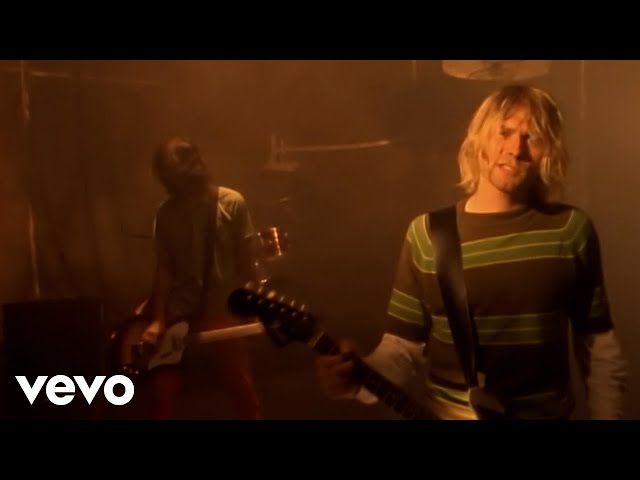
“Smells Like Teen Spirit” arrived in 1991 and altered the trajectory of rock culture. The official music video, directed by Samuel Bayer early in his career, distilled Nirvana’s volatile mix of melody, noise and skepticism into a single, indelible image: a high school pep rally that mutates into revolt. Broadcast on heavy rotation and seared into the collective memory of a generation, it became a shorthand for the jolt that Nevermind sent through the mainstream.
Inside the Gym: Symbols of Rebellion
The video stages its confrontation with American youth iconography in a fluorescent-lit gym, where bleachers, pom-poms and a school banner promise order. The promise doesn’t hold. Cheerleaders grin through black anarchy symbols, a janitor dances with his mop, and a sea of bored students slowly shifts from passivity to chaos. Bayer’s camera prowls as fog creeps along the gym floor and the color palette veers toward a sickly yellow-green, visualizing the song’s queasy churn of euphoria and unease.
By the final chorus the crowd floods the floor, turning the pep rally into a mosh pit and the podium into wreckage. The carefully constructed pageantry of school spirit collapses under feedback and flannel. It is subversion rendered as ritual: the band performs, the crowd erupts, the set dissolves.
Sound and Structure: The Spark in the Riff
Musically, “Smells Like Teen Spirit” is precision-engineered catharsis. A jagged, four-chord guitar figure opens the track and immediately loops into memory. Krist Novoselic’s bass locks to the roots with iron simplicity, while Dave Grohl’s drumming fires on snare bursts and crashing cymbals that carve the song into breath-and-blast sections. The classic quiet-verses/loud-chorus model is executed with scalpel accuracy, the verses hovering on a clean, slightly detuned shimmer before the distortion detonates.
Kurt Cobain’s voice seals the effect. He doubles lines for extra grain and impact, then lets them fray at the edges. Producer Butch Vig captured the friction between abrasion and melody, a balance sharpened for radio without blunting the song’s teeth. The hook is immediate, but it grinds and scrapes as it lands.
Language, Irony and the Teen Spirit Myth
“Here we are now, entertain us” became the song’s calling card, a line that reads as both deadpan joke and cultural diagnosis. Cobain’s lyrics skew cryptic and suggestive rather than literal, poking at boredom, conformity and spectacle. Even the title arrived half in-jest: the phrase “Smells Like Teen Spirit” came from graffiti by Kathleen Hanna of Bikini Kill, a sly nod to a popular deodorant that Cobain reportedly didn’t clock as a brand at first. The accidental poetry stuck, and its ambiguity intensified the song’s reach.
Making the Image: Direction, Casting and Controlled Chaos
Bayer’s approach fused grime with pop clarity. The camera drifts low across sneakers and scuffed gym floors, then knifes upward into faces, amplifying the shift from apathy to catharsis. Lighting blooms through haze, creating halos around cymbals and sweat. The edit toggles between performance and reaction shots, registering the crowd’s slow-burn impatience before the final crush.
Local fans were invited as extras, encouraged to look disaffected and, when the cue arrived, to tear into the set. The anarchic cheerleaders and the grinning janitor became near-mythic figures, totems of the video’s refusal to play pep-rally straight. What begins as a knockoff of school spirit becomes a study in spontaneous disorder.
From Underground Rumble to Global Signal
Nirvana’s leap from club stages to global ubiquity was not the work of this video alone, but it is impossible to picture that leap without it. Airwaves and cable channels ran it relentlessly, pulling regional scenes and aesthetics into the mainstream overnight. Flannel and thrift-store silhouettes became a visual vernacular, while labels recalibrated their expectations for guitar music. For many, this was the first sight and sound of the Seattle-linked alternative movement; for others, it was proof that punk energy could still rupture pop’s surface.
Why It Endures
The “Teen Spirit” video endures because it resists perfect clarity. It offers iconography and ambivalence in equal measure. Is the crowd liberated or just destructive? Is the song’s hook an invitation or a taunt? The ambiguity lets the video breathe across decades, resurfacing in new contexts without losing its bite. Its grammar—low-budget grit, charged symbolism, performance-as-riot—echoes through countless rock and pop clips that followed.
Nevermind at 30: A Clearer Lens on the Shockwave
The 30th anniversary edition of Nevermind revisits the moment with archival depth. The album has been newly remastered from the original half-inch stereo analog tapes, a process that clarifies the record’s punch without sanding off its edges. Alongside the studio material, the edition includes four previously unreleased international live shows from Amsterdam, Netherlands; Del Mar, California; Melbourne, Australia; and Tokyo, Japan. Together they track the band at full sprint as the songs outgrew small rooms and met larger, louder crowds.
- A remaster from original half-inch stereo analog tapes that preserves grit while enhancing detail.
- Four complete live sets capturing the band’s attack across different continents and rooms.
- A broader portrait of how the songs translated from studio precision to stage volatility.
The Legacy in One Frame
Freeze the “Smells Like Teen Spirit” video at almost any point and the frame reads as a statement: a stare from the bleachers, the flash of an anarchy symbol, a crash of cymbals cutting through smoke. It is a rare artifact that functions as both document and catalyst, mapping a cultural turn while helping to create it. Three musicians on a makeshift stage in a mock gymnasium made global music feel local again, then made that locality explode. The aftershocks are still audible.
Nirvana – Smells Like Teen Spirit (Official Music Video) Related Posts
- It’s Not Because of YouThe article discusses the song "It's Not Because of You" …
- Lamb of God – Grayscale (Official Lyric Video)Lamb of God's official lyric video for "Grayscale" explores themes …
- Black Road – Bloody Mary (OFFICIAL VIDEO)Black Road's "Bloody Mary," featuring Suzi Uzi on vocals, showcases …
- The Winery Dogs – Captain Love (Official Music Video)The Winery Dogs have released the official music video for …
- Should I Stay or Should I Go (Remastered)The remastered version of "Should I Stay or Should I …
- Motionless In White – Reincarnate (Official Music Video)The official music video for "Reincarnate" by Motionless In White …