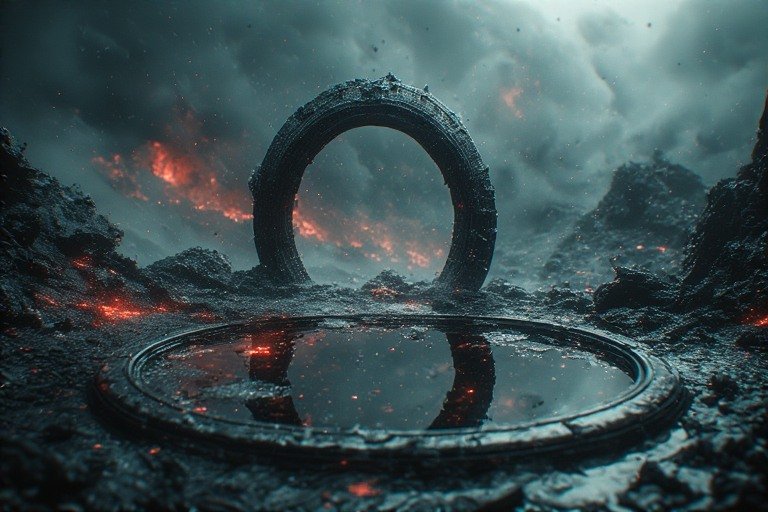
Naunet is a significant entity within the ancient Egyptian mythology, recognized as the female aspect of the primordial waters. This entity is often associated with the concept of chaos and the potential for creation, embodying the vast, formless waters that existed before the creation of the world. In the Egyptian cosmology, Naunet is linked to the Ogdoad, a group of eight deities representing the primordial elements of the universe, including darkness, infinity, and the waters of chaos.
In terms of cultural and mythological origins, Naunet’s roots can be traced back to the early dynastic periods of ancient Egypt, where she was venerated alongside her male counterpart, Nun, who represents the male aspect of the primordial waters. Together, they symbolize the duality of creation and the balance necessary for the emergence of the ordered world from chaos.
Naunet’s attributes and symbolism are deeply intertwined with the themes of fertility and creation. As the female embodiment of the waters, she is often depicted as a source of life, nurturing the potential for existence. In various texts and depictions, Naunet may be represented as a woman with a water pot or as a figure associated with the aquatic environment, emphasizing her connection to the life-giving properties of water. Furthermore, she is sometimes linked to the concept of the divine womb, from which all creation emerges.
Historically, Naunet’s influence can be seen in the broader context of Egyptian creation myths, particularly in the Heliopolitan cosmology, which emphasizes the emergence of the sun god Ra from the waters of chaos. Although Naunet may not have been as widely worshipped as other deities, her role within the mythological framework highlights the importance of water as a fundamental element in the creation narrative. Later interpretations of Naunet are limited, as she did not transition into later folklore or occult traditions, maintaining her status primarily within the confines of ancient Egyptian religious practices.
In summary, Naunet serves as a vital representation of the primordial waters in ancient Egyptian mythology, embodying the dual aspects of creation and chaos. Her legacy endures as a testament to the significance of water in the ancient understanding of the universe’s origins.