Overview
Electric Eye stands as one of Judas Priest’s defining statements, a high-velocity anthem that paired razor-sharp riffs with a dystopian vision of constant surveillance. The official video, released in 2012 under the band’s imprint and licensed to Sony Music Entertainment UK, presents the song with a vivid sense of motion and spectacle, channeling the group’s leather-and-chrome aesthetic while underscoring the track’s technological paranoia. Four decades after its debut on the 1982 album Screaming for Vengeance, Electric Eye remains a reliable jolt of precision-engineered heavy metal, instantly recognizable for its entrance after the instrumental overture The Hellion.
Origins and Context
First issued in 1982 on Screaming for Vengeance, Electric Eye arrived during a peak period for Judas Priest, as the band refined the blueprint for modern heavy metal. The song was written by the classic core of Rob Halford, Glenn Tipton, and K.K. Downing, and produced by Tom Allom, whose clarity-minded approach helped crystallize Priest’s twin-guitar attack for a global audience. Pairing The Hellion’s stately, harmonized fanfare with the song’s immediate, hard-charging riff created a seamless, theatrical opener that would become a hallmark of the band’s live shows and one of the genre’s most memorable transitions.
Lyrical Focus
Electric Eye adopts the perspective of an omniscient watcher. Halford’s lyrics evoke a network of cameras and control rooms, where privacy dissolves under a mechanized gaze. The narrative spirit feels both sci-fi and prescient, capturing early-1980s anxieties about new technologies, data collection, and the blurring of civil liberties in the name of security. Rather than offering a literal storyline, the song leans into mood and imagery: satellites, monitors, and the “eye in the sky” as a symbol of authority without accountability. That fusion of futurist dread and hard-rock bravado sits at the core of Priest’s appeal, casting sleek metal as a vehicle for social unease.
Sound and Performance
Electric Eye is a masterclass in economy and impact. The arrangement wastes no space, building tension with The Hellion’s guitar harmonies before dropping into a swift, palm-muted main riff. Tipton and Downing trade accents and lines with aerodynamic precision, shifting between unison punches and stacked harmonies that feel engineered for colossal stages. Halford’s performance ranges from clipped, commanding verses to stratospheric peaks, his upper register cutting through the mix with a metallic sheen that defined the era.
The rhythm section locks the track in place with a tight, forward drive. Ian Hill’s bass underpins the guitars with unshowy but crucial ballast, mirroring the riff to intensify its momentum. The drumming is crisp and metronomic, favoring rapid, straight-ahead patterns that propel the song’s urgency. The guitar solo section, lyrical and fluid despite its speed, reinforces the tune’s surveillance motif by sounding both clinical and soaring, as if soaring above the terrain it observes. Production choices emphasize clarity over murk, giving the track a bright, high-gain edge that still reads as powerful in contemporary settings.
The Video
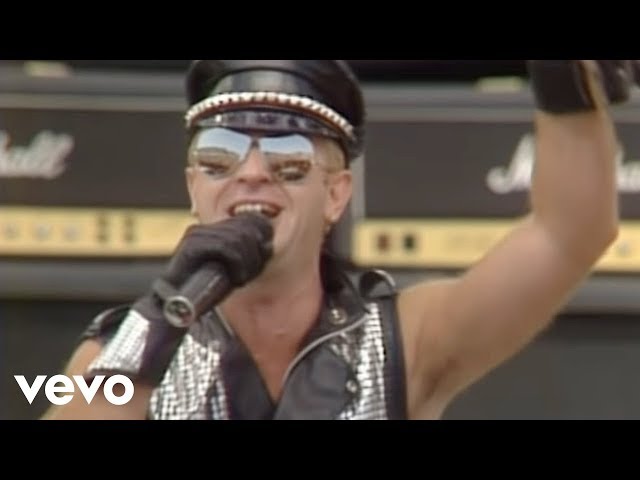
The official video amplifies the track’s themes through performance and imagery. The band’s onstage presence—black leather, studs, mirrored shades—matches the sleek menace of the music. Quick-cut editing, stark lighting, and mechanical motifs lean into the idea of being watched and recorded, turning the stage into a controlled environment that mirrors the song’s control-room metaphors. The result is a classic early-’80s metal promo aesthetic, where visual punch serves the song’s staccato rhythms and insistent hooks.
While the presentation embraces spectacle, it keeps the focus on interplay and impact: the synchronized guitar lines, Halford’s stiletto phrasing, and the rhythm section’s tight lock. The visuals feel built to underline the coupling of The Hellion and Electric Eye, translating one of heavy metal’s most reliable live openers into a concise, high-intensity burst.
Why It Endures
Electric Eye endures because it captures Judas Priest’s fundamental strengths in under five minutes. The song is immediate yet sophisticated, sleek yet heavy, theatrical without excess. Its subject matter has only grown more resonant as surveillance technologies have become ubiquitous, lending contemporary weight to a track born of analog tape and towering stacks. For generations of metal fans, the surge from The Hellion into Electric Eye is a rite of passage, an archetypal moment where riff, voice, and vision align.
As part of the Screaming for Vengeance era, the track also helped codify what would become a lingua franca for metal guitar: twin-lead harmonies, tightly gated rhythm tones, and solos that balance melody with velocity. Many bands chased similar textures, but few achieved the same balance of polish and bite. The official video’s 2012 release brought that legacy into the digital age, presenting one of Priest’s signature cuts in a format built for online discovery without diluting its analog ferocity.
Lineup and Creative Credits
- Rob Halford – vocals
- Glenn Tipton – guitars
- K.K. Downing – guitars
- Ian Hill – bass
- Dave Holland – drums
- Produced by Tom Allom
Release Notes
Electric Eye originally appeared on Judas Priest’s 1982 album Screaming for Vengeance. The official video was issued in 2012 under the credit:
(c) 2012 Judas Priest Music Limited under exclusive licence to Sony Music Entertainment UK Limited
A centerpiece of Priest’s catalog, the track continues to open shows, anchor compilations, and introduce new listeners to the group’s chrome-plated vision of heavy metal at full throttle.
Judas Priest – Electric Eye (Official Video) Related Posts
- Myst Man – Crown of Sorrow | A dark and emotional song that tells the story of a fallen queen"Crown of Sorrow" is a poignant song that narrates the …
- Coven- Wicked woman rare ”live” perfromance, 1969Coven, known for their occult rock influence, is featured in …
- Metallica: You Must Burn! (Official Music Video)Metallica has released the official music video for "You Must …
- Twilight Covenant"Twilight Covenant" is a multimedia piece that combines visual and …
- UNLEASH THE ARCHERS – AwakeningUNLEASH THE ARCHERS celebrates a decade of heavy metal excellence …
- INXS – Suicide Blonde"Suicide Blonde" marks the first single from INXS's seventh album, …