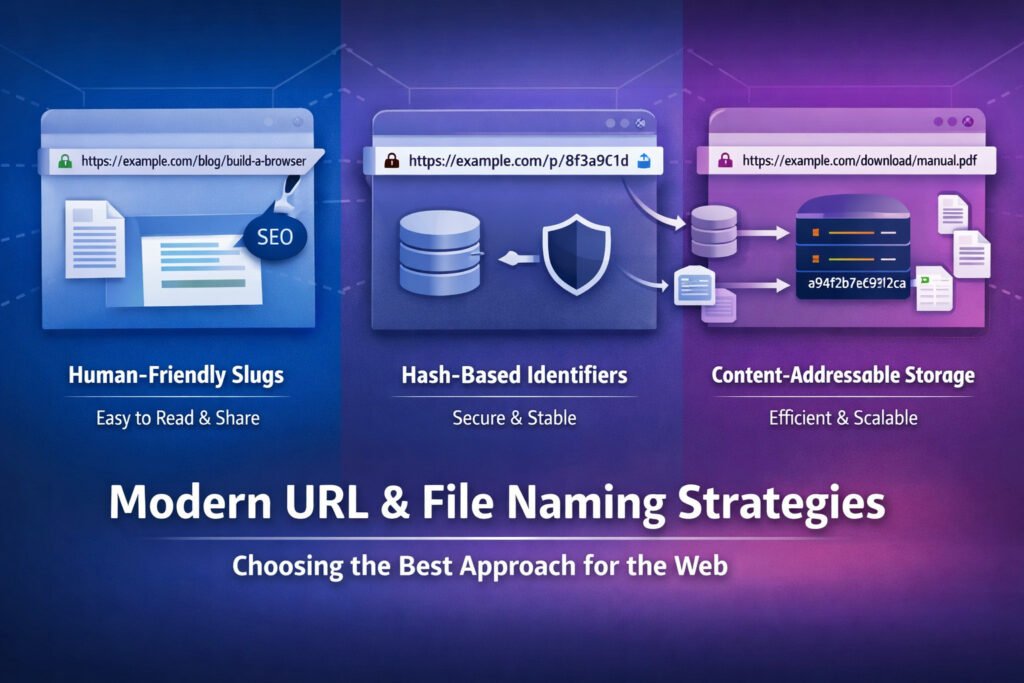
In the early days of the web, file and page names directly reflected their physical location on a server. Today, that relationship has largely disappeared. Modern platforms separate what users see from how data is actually stored, enabling scalable, secure, and high-performance architectures.
This article explores three major approaches to naming pages and files on the web:
- Human-readable slugs
- Hash-based identifiers
- Content-addressable storage with friendly URL rewriting
Understanding the strengths and trade-offs of each approach is essential for developers, system architects, and site owners alike.
🏷️ Human-Friendly Slugs
A slug is a readable identifier derived from a title or description.
Examples:
https://example.com/blog/how-to-build-a-browser
https://example.com/products/ergonomic-office-chair
Advantages
SEO benefits — Search engines use keywords in URLs as ranking signals.
User trust — Visitors can anticipate content before clicking.
Memorability — Easy to share verbally or in print.
Clear site structure — Helps users navigate by editing the URL.
Readable analytics — Logs and reports are human-interpretable.
Disadvantages
Link fragility — Changing a title may change the slug, breaking links.
Information exposure — URLs reveal content structure.
Uniqueness issues — Duplicate titles require suffixes.
Enumeration risk — Attackers can guess valid paths.
Localization complexity — Special characters require encoding.
Hash-Based Identifiers
In this model, resources are referenced by opaque IDs or hashes.
Examples:
https://example.com/p/8f3a9c1d
https://example.com/file/a94f2b7e6c91
These identifiers may be UUIDs, database IDs, or cryptographic hashes.
Advantages
Stability — IDs never change even if content does.
Implementation simplicity — No need to generate unique slugs.
Language neutrality — Works across all locales.
Better privacy — URLs do not reveal meaning.
High scalability — Ideal for distributed systems.
Disadvantages
Poor SEO — No semantic information.
Bad user experience — Hard to remember or share.
Weak marketing value — URLs convey nothing about content.
Opaque analytics — Logs require lookup tables.
Non-intuitive navigation — Users cannot infer structure.
Content-Addressable Storage with Friendly URLs
A more advanced approach separates storage identity from public naming.
The system stores files using a hash of their content (Content-Addressable Storage, or CAS), while exposing human-friendly URLs through rewriting or metadata mapping.
How It Works
Physical storage:
/storage/a9/4f/a94f2b7e6c91f2c8e8c4e7...
Public URL:
https://example.com/download/product-manual.pdf
A database or routing layer maps the friendly name to the underlying hash.
✅ Key Benefits
Deduplication
Identical files share the same hash, so they are stored only once.
Integrity Verification
If the content changes, the hash changes. This prevents silent corruption and unauthorized modification.
Efficient Caching
Hashed assets can be cached almost indefinitely because they are immutable.
Natural Immutability
Perfect for versioning, backups, legal records, and distributed systems.
Name Independence
Multiple URLs can reference the same physical object:
/manual-en.pdf
/manual-pt.pdf
/latest-manual.pdf
❌ Challenges
Higher architectural complexity — Requires metadata management.
Lookup overhead — Additional step before serving content.
Garbage collection — Orphaned objects must be cleaned up.
Update semantics — Editing creates new objects instead of replacing old ones.
🌍 Real-World Implementations
Several major technologies rely on content-addressable storage:
- Git stores files, trees, and commits by hash
- Docker uses hashed layers for container images
- IPFS identifies files directly by content hash
These systems demonstrate how powerful this model can be at scale.
Hybrid URL Patterns
Many modern platforms combine human readability with machine reliability.
Slug only
/how-to-build-a-browser
Hash only
/file/a94f2b7e6c91
Slug + ID (recommended)
/how-to-build-a-browser-a94f2b7
In hybrid models, the backend uses the ID while the slug improves usability and SEO.
Choosing the Right Strategy
Use slugs when:
- Content is public
- SEO matters
- Branding and shareability are priorities
Use opaque IDs when:
- Content is private or sensitive
- You are building APIs or internal systems
- Stability is critical
Use content-addressable storage when:
- Handling large volumes of files
- Requiring deduplication and integrity guarantees
- Building cloud storage, backups, or distributed platforms
Final Thoughts
Modern web architecture no longer forces a choice between human readability and machine efficiency. By decoupling public URLs from physical storage, developers can achieve the best of both worlds: intuitive navigation for users and mathematically reliable data management behind the scenes.