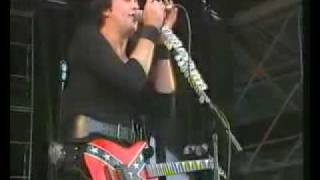
Castle Donington, 1992: A Concept Brought to the Arena
At the 1992 Monsters of Rock festival in Castle Donington, W.A.S.P. stepped into a transitional moment for heavy music and for their own catalogue. Grunge and alt-rock were tightening their grip on the mainstream, yet this California-born band arrived with a sweeping concept record, The Crimson Idol, and the conviction to bring its most ambitious material to one of rock’s most unforgiving proving grounds. Among the selections aired from the album, the climactic suite The Great Misconceptions of Me stood out as a bold choice: a multi-part finale transplanted from the intimacy of headphones to a field full of raised fists.
The Crimson Idol in Focus
Released in 1992, The Crimson Idol is W.A.S.P.’s dark parable about a young outcast who becomes a rock star, only to find emptiness where adulation should be. It is a narrative about identity, the corrosion of fame, and the ache of parental rejection. Written and largely directed in the studio by Blackie Lawless, the album trades shock-rock provocation for a cinematic sweep. Lawless handled vocals, bass, rhythm guitars, and keys, with session greats Bob Kulick on lead guitar and Frankie Banali on drums shaping the record’s cutting edge and thunder. The production favors wide, layered guitars, muscular tempos, and brooding melodic figures that knit the story together across its running time.
The Closing Statement: Anatomy of “The Great Misconceptions of Me”
As the album’s culminating track, The Great Misconceptions of Me functions like a final act and curtain call in one. Musically, it moves in chapters: a tense, almost elegiac introduction that invokes earlier motifs from the record; a surge into churning, palm-muted riffs; and a sweeping midsection where melodic guitar lines pull against the rhythm like a tide. You hear recurrences of themes suggested in songs like “The Idol” and “Chainsaw Charlie,” but they are reframed with the gravity of consequences. The arrangement sets up dynamic contrasts—quiet admissions interrupted by hard, declarative riffing—mirroring the protagonist’s collision of public persona and private collapse.
Live, the piece invites long arcs of tension and release. The chord voicings favor open strings and sustained tones that allow harmonized leads to cut through, while the rhythm section locks into stern, almost martial pulses before loosening into backbeat swagger. Blackie Lawless’s vocal approach in this era leaned into raw timbre and pathos: cracked edges on higher peaks, a chesty grain in the lower range, and a sense of emotional pacing that made the final sections land with weight.
Translating a Studio Epic to the Donington Stage
Bringing The Crimson Idol to a festival demands more than volume. The album’s detail—layered guitars, orchestral pads, and narrative threads—had to be condensed into a punch that worked outdoors. W.A.S.P.’s touring band built a two-guitar foundation to carry the intertwining melodies, with rhythm parts thickened to stand in for keys and strings. The cymbal work rose in the mix for extra articulation in open air, and the low end was kept tight to keep the midrange guitars clear. Chorused clean tones in the intro passages created a halo effect before the gain ramped up, and harmonized leads amplified the album’s leitmotifs without needing full orchestration.
Crucially, the theatrical element shifted from props to performance. Earlier in their career, W.A.S.P. had a reputation for shock-value visuals. By 1992, the drama was in the songs. The lighting and backdrop nodded to The Crimson Idol imagery, but the real narrative came from dynamics and delivery: a band that alternated between clenched-jaw precision and lingering, vocal-led rubato at key turns in the piece.
Sound and Musicianship
The sonic character of W.A.S.P.’s 1992 live approach balanced bite and breadth:
- Guitars: A saturated, mid-forward crunch carried the body of the song, with a secondary voice reserved for lyrical leads and harmonized statements. Where the album uses layered overdubs for scale, the live guitars leaned on harmony intervals and sustained bends to simulate that mass.
- Vocals: Lawless’s phrasing prioritized storytelling clarity over strict album fidelity, stretching or clipping lines to suit the moment. The choruses came with stacked backing vocals to reinforce hooks without diluting the grit.
- Rhythm section: Drums favored punchy toms and a snare tuned to crack, keeping the arrangement articulate in the festival mix. Bass traced the guitar figures closely in heavier sections, then stepped forward during transitions with slides and brief countermelodies to keep momentum.
Why This Moment Resonates
Performing a concept-album finale on a massive outdoor stage is a statement of intent. In 1992, many veteran metal acts were recalibrating for changing tastes. W.A.S.P. doubled down on narrative songwriting and dramatic scope. The Great Misconceptions of Me encapsulates that decision. Its themes of disillusionment and identity crisis were legible across the field, even stripped of the album’s spoken interludes. The band underscored how heavy metal, at its best, can accommodate big stories and bigger emotions without sacrificing impact.
The decision to spotlight this piece at Monsters of Rock also helped situate The Crimson Idol within the band’s live legacy. What began as a studio-driven vision proved resilient in front of one of the densest and most demanding audiences in rock, affirming that the record’s material was built for the stage as much as for the concept.
What to Listen For in Live Renditions
- Motivic callbacks: Guitar figures that echo earlier moments on the album, used as connective tissue in transitions.
- Dynamic plateaus: Sections where the band holds a groove at high intensity before breaking into half-time or a clean-toned respite.
- Vocal inflection: Lines delivered with extra grit or hushed intensity to replace the album’s narration with performance emphasis.
- Harmonized leads: Two-guitar passages that broaden the melody in lieu of orchestral textures.
- Final cadence: A closing run that resists neat resolution, musically mirroring the story’s moral ambiguity.
Context Within W.A.S.P.’s Evolution
W.A.S.P. rose from Los Angeles’s metal crucible with a taste for provocation and hooks that could fill arenas. By the late 1980s, the band was increasingly preoccupied with social and personal themes, shifting toward more structured drama without abandoning their bite. The Crimson Idol crystallized that turn. Bringing its finale to Castle Donington in 1992 made clear that W.A.S.P. intended to be judged not only by shock and swagger, but by songwriting scope and narrative ambition.
Closing Perspective
The Great Misconceptions of Me at Castle Donington stands as a marker in W.A.S.P.’s story: a high-wire act where a concept album’s emotional core met the scale of a landmark festival. It was a pointed reminder that, even as the musical landscape shifted, the band could command a vast space with a piece built from tension, melody, and hard truths. The performance distilled The Crimson Idol to its essentials—voice, riffs, pulse—and in doing so, proved the album’s heart beats loudest under open skies.
W.A.S.P. The Great Misconceptions of Me live at Castle Donington 1992 Monsters ot Rock Related Posts
- SIRENIA – The Other Side (OFFICIAL MUSIC VIDEO)The official music video for Sirenia's "The Other Side," featured …
- BEYOND THE BLACK – Free Me (OFFICIAL MUSIC VIDEO)The official music video for "Free Me," a track from …
- Red Hot Chili Peppers – Black Summer (Official Music Video)The official music video for "Black Summer" by Red Hot …