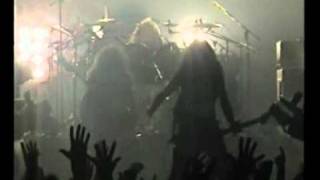
A Ferric Snapshot of Sepultura in 1991
This live capture of Sepultura performing Arise in Barcelona, 1991, is more than a single-song document. It is a surge of early 90s extremity from a band in rapid ascent, delivering a title track that had already become shorthand for their sharpened blend of thrash precision and death-metal severity. Circulating as a .wmv file with Spanish subtitles, the clip preserves a moment when the Brazilian quartet were converting new audiences across Europe with relentless focus and unfiltered power.
Context: The Arise Era
Released in 1991 on Roadrunner Records and recorded at Morrisound Studios with producer Scott Burns, the Arise album represented a decisive refinement of Sepultura’s sound. Coming off the breakthrough of Beneath the Remains, the band pushed for greater clarity and speed while threading in darker textures, tighter arrangements, and a more commanding vocal presence. These were years when the line between thrash and death metal blurred, and Sepultura stood on that fault line with confidence.
By the time the tour hit Barcelona, the group’s identity was fully formed. The pace was punishing, the attack razor-edged, and the live mix favored impact over nicety. What makes the Barcelona performance compelling is how faithfully it channels the studio recording’s precision while intensifying its menace.
The Song as Statement
Arise functions as a thesis for the record that bears its name. Lyrically, it circles themes of societal collapse, militarism, and spiritual corrosion. The language is apocalyptic but purposeful, sketching a world frayed by technological escalation and violent authority. Musically, the piece marries galloping thrash beats with lean, chromatic riffing, sudden rhythmic pivots, and a chorus built for call-and-response. It is streamlined yet volatile, a blueprint for much of the heavy music that followed in its wake.
Inside the Barcelona Performance
From the opening riff, the band’s chemistry is unmistakable. The tension-release of the main figure sharpens the crowd’s focus, and the shift from intro surge to verse discipline arrives like a switch being thrown. When the chorus lands, the room moves as one. That sense of collective ignition, common to early 90s metal shows, amplifies every accent and crash. You hear it in the staccato chug of the rhythm guitar, in the crisp snap of the snare, and in the chest-thump of the double kick. The performance is tight, but never clinical. It breathes with the room.
Sound, Technique and Delivery
Much of Arise’s live power comes from carefully layered parts delivered with zero hesitation:
- Vocals: Max Cavalera’s bark is hoarse yet projective, locking syllables to the rhythm in a way that turns political angst into a physical cadence. The chorus cuts through clearly, built for a crowd that already knows the punchline.
- Guitars: Andreas Kisser’s lead voice snakes above the rhythm bed with fast-picked lines, dissonant bends, and agile, tightly framed solos. Max’s rhythm anchoring emphasizes percussive palm-mute patterns and abrupt stops, giving each transition a hard edge.
- Bass: Paulo Jr. occupies the same sternum-rattling space as the kick drums, reinforcing the root motion and fleshing out the low end so that even rapid passages feel weighty.
- Drums: Igor Cavalera’s command of momentum is the engine. Thrash beats lock into muscular double-bass bursts, tom figures set up transitions, and cymbal work articulates the song’s structural markers without clutter.
The result is a performance that feels both ruthless and legible. Even at speed, you can follow the architecture, from verse tension to chorus release, to the solo section’s brief flare of chaos before the final onslaught.
Spanish Subtitles and Lyrical Reach
The presence of Spanish subtitles does more than translate. It reframes the song’s political and existential charge for a wider Iberian and Latin American audience, letting non-English speakers grasp nuances of imagery and intent. Lines about authority, conflict and dehumanization land differently when experienced in one’s first language, especially in a live setting, where immediate comprehension can feed the energy loop between stage and floor. Subtitled metal videos have long served as an informal bridge across scenes, and this clip underscores that role.
Barcelona Energy, European Momentum
Spain’s heavy music audience in the early 90s was hungry for speed, aggression, and a sense of global connection. Sepultura arrived with all three. The Barcelona crowd’s response affirms the band’s status as a transcontinental force, a group from Brazil that had seized the attention of European rooms by refining velocity into form. You can sense a feedback loop at work: the tighter the band plays, the louder the room answers, which pushes the next section to hit harder still.
Why This Clip Endures
Part of this video’s endurance lies in its balance of immediacy and time-capsule charm. It captures the sound of a classic album distilled into a single strike, showing why Arise became a cornerstone for generations of extreme metal fans. It also preserves the visual and sonic artifacts of its era, from stagecraft stripped of adornment to a mix that privileges drums and guitar bite over modern polish. As a reference point for where Sepultura stood in 1991, it is concise and convincing.
Format Notes: The .wmv Patina
The .wmv encoding bears hallmarks of early digital circulation: compressed audio with a midrange tilt, blacks that bloom, and motion blur around fast picking hands and flailing hair. Rather than obscure the performance, these artifacts act like the grain of analog tape. They remind us of how live metal traveled in the pre-streaming age, across tapes, discs and early file shares, often subtitled by fans to reach new listeners. For collectors, that patina is part of the appeal.
Aftershocks and Legacy
Arise stands as a pivot point, tightening the ferocity of the band’s late 80s work and setting up the rhythmic weight they would explore later in the decade. The Barcelona rendition highlights how that transition sounded on stage: brutal, exact, and designed for collective release. Many bands learned from this model, from the way riffs are articulated to how social critique can be delivered with blunt force and clarity.
Personnel
- Max Cavalera – vocals, rhythm guitar
- Andreas Kisser – lead guitar
- Paulo Jr. – bass
- Igor Cavalera – drums
Viewed today, Sepultura’s Arise in Barcelona is not just a document of a great song played loud. It is a precise, era-defining snapshot of a band uniting velocity, vision and crowd energy into one unforgiving strike.
Sepultura – Arise (subtitulado en español) live in Barcelona (1991) .wmv Related Posts
- Ghost – Square Hammer (@Violet Orlandi ft @Jonathan Young COVER)Violet Orlandi and Jonathan Young have collaborated on a cover …
- Evanescence – Good EnoughEvanescence's music video for "Good Enough," released in 2006, showcases …
- City of Setealem Feat Evil Beauty | inspired by the Brazilian urban legend of Setealém"City of Setealem" draws inspiration from the Brazilian urban legend …
- Evil Beauty – The Veil Between Worlds | A song about the space between existence and oblivion"The Veil Between Worlds" explores the delicate boundary between existence …
- ELEINE – We Stand United (OFFICIAL VIDEO)ELEINE has released the official video for "We Stand United," …
- Belle Nielis – Circle of the Hollow Moon | Inspired by Wiccan and Celtic invocation ritualsThe song "Circle of the Hollow Moon" by Belle Nielis …