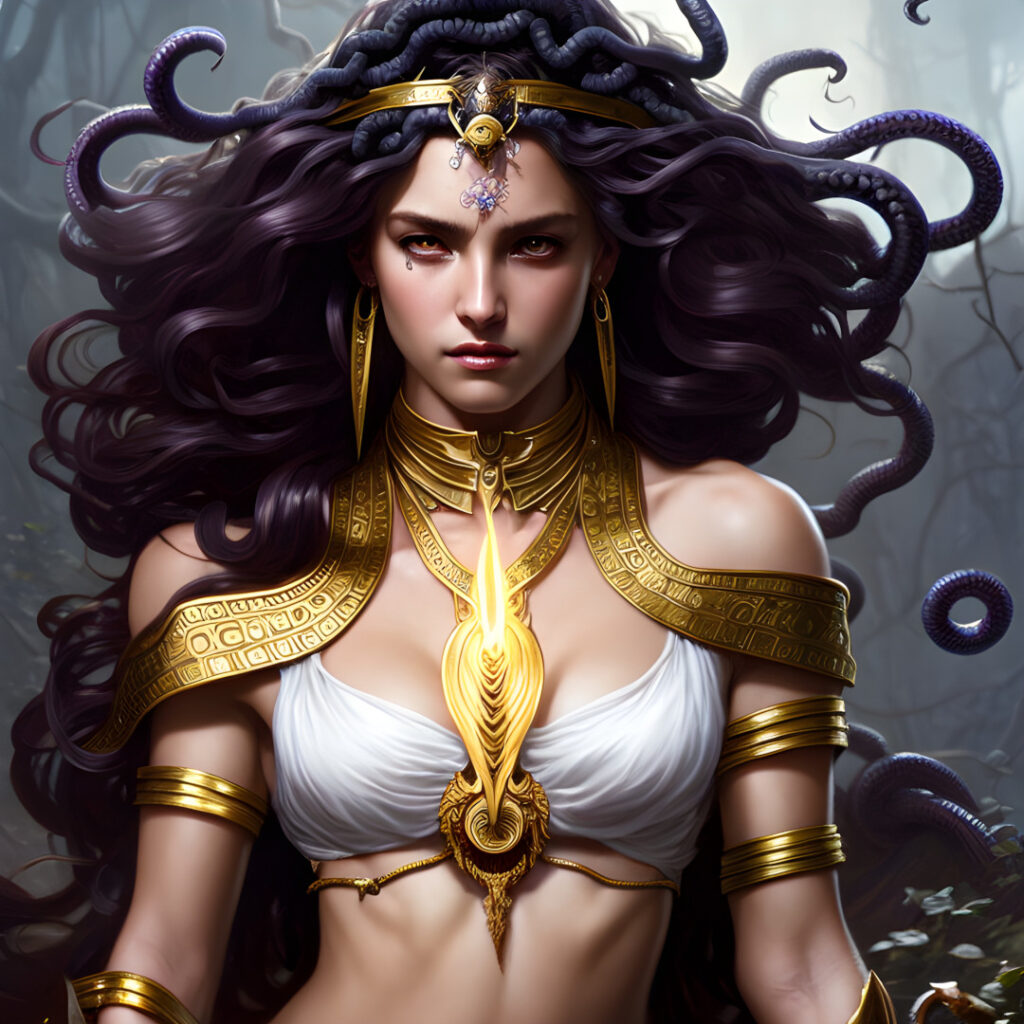
Medusa is a character from Greek mythology, known for her appearance as a woman with snakes for hair and the ability to turn people to stone with her gaze. According to the myth, Medusa was once a beautiful woman and a priestess of Athena, but she was cursed by the goddess after she caught Poseidon, god of the sea, raping her in Athena’s temple. Athena punished Medusa by turning her hair into snakes and making her so hideous that anyone who looked upon her face would be turned to stone.Medusa is often depicted as a monster and a villain in Greek mythology, but some interpretations suggest that she was actually a victim of the gods’ cruelty. In some versions of the myth, Medusa’s curse is seen as a punishment for her own pride and vanity, while in others she is seen as an innocent victim of Poseidon’s lust and Athena’s wrath.
Medusa’s image has become a popular symbol in art, literature, and pop culture, often representing the dangers of temptation and the power of female beauty. She has been featured in countless works of fiction, from ancient Greek plays to modern movies and video games.
Medusa Related Posts
- MedusaMedusa, a figure from Greek mythology, is often depicted as …
- Mythic Echoes: The Ancient Prophecy of NFT Music TokensExplore the intersection of ancient prophecy and modern creativity through …
- The Allure of Darkness: Nahemah Legion and the Intersection of Music and MystiqueNahemah Legion's NFT collection invites exploration of the dark and …
- Echoes of the Unspoken: The Intersection of Music, Emotion, and TechnologyExplore the transformative power of NFT music tokens through the …
- NFT Collections in Music: A New Era of Artistic ExpressionExplore how NFT collections are transforming the music landscape, enabling …
- The Resonance of Damballa: A Journey Through Music and CultureDiscover how the spirit of Damballa, a key figure in …